
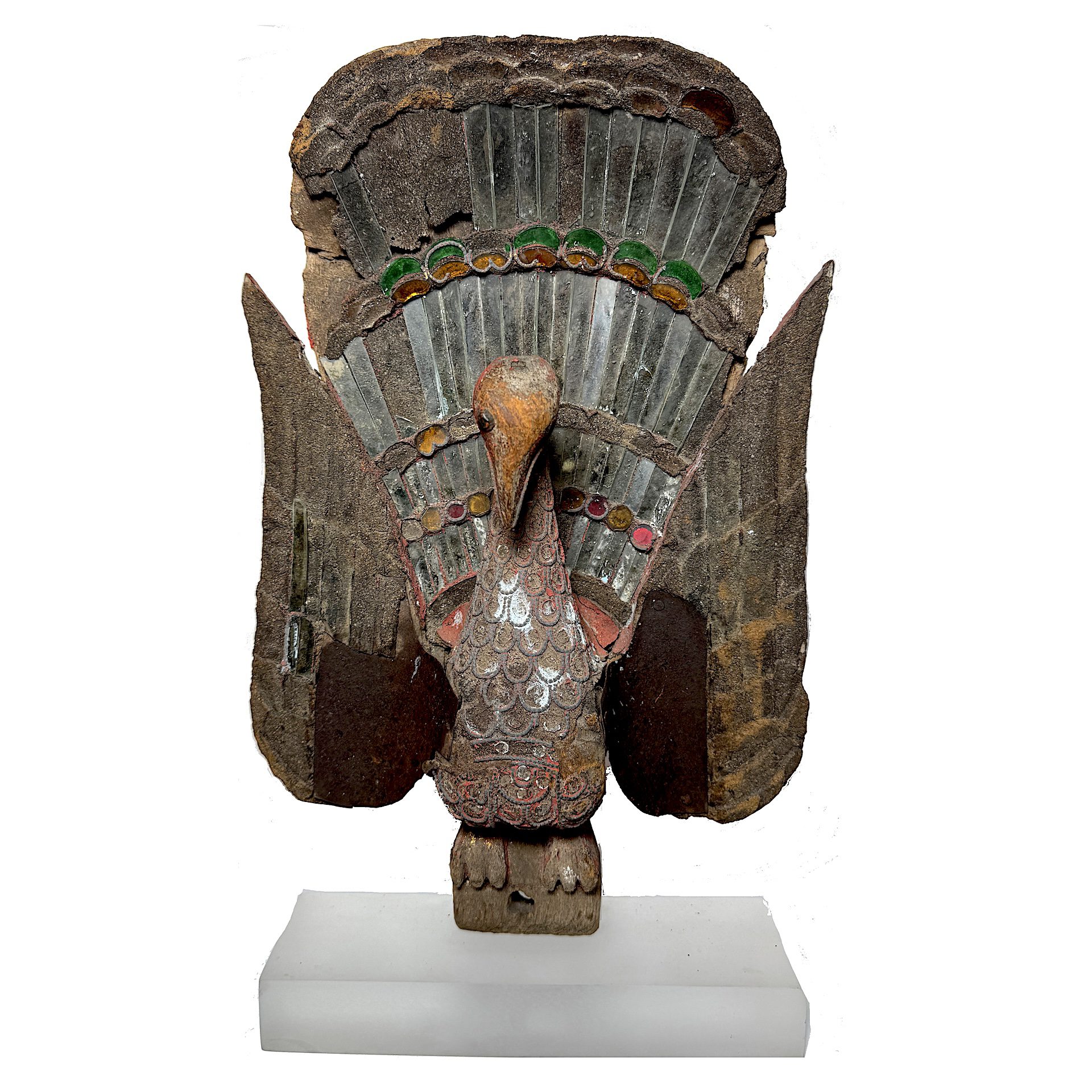
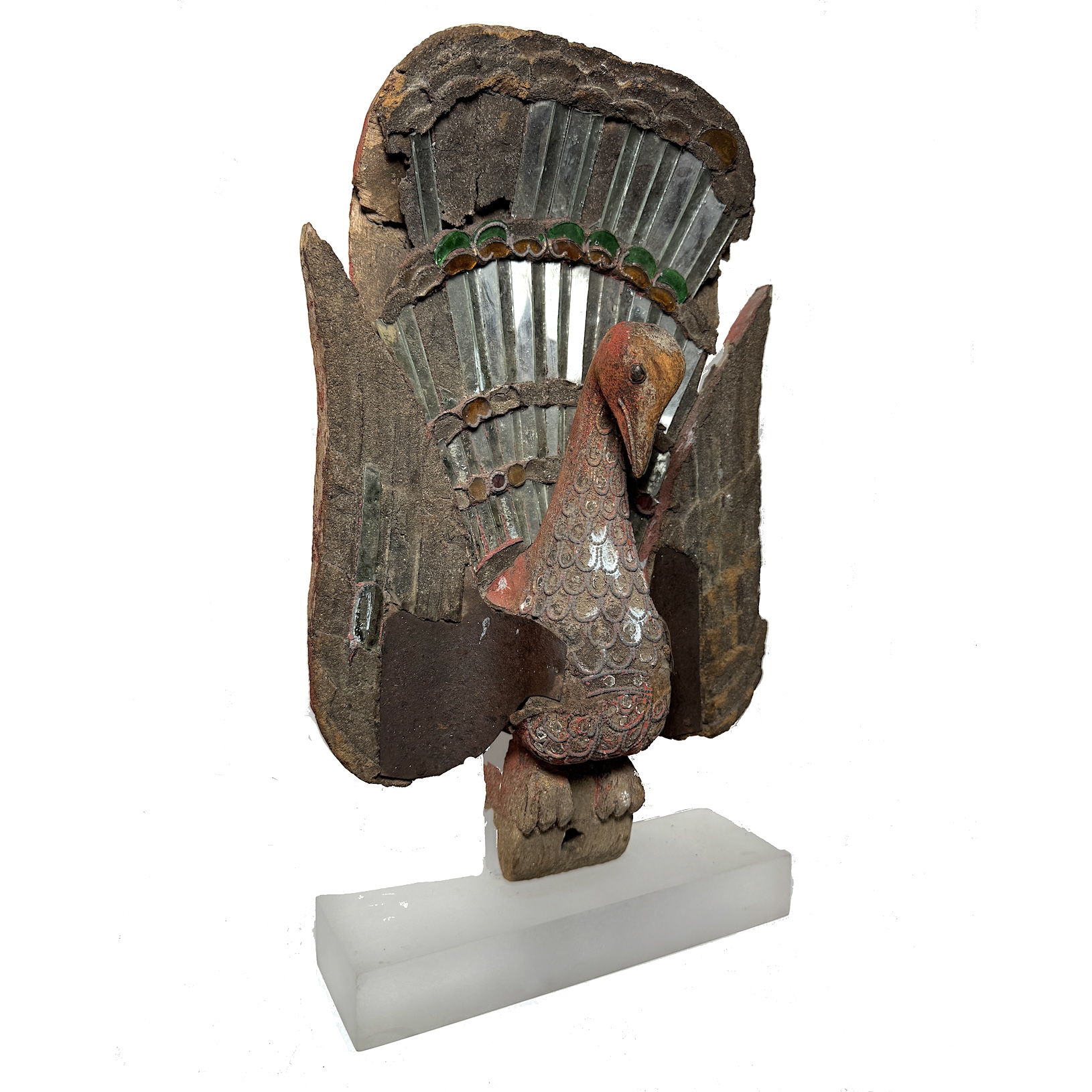
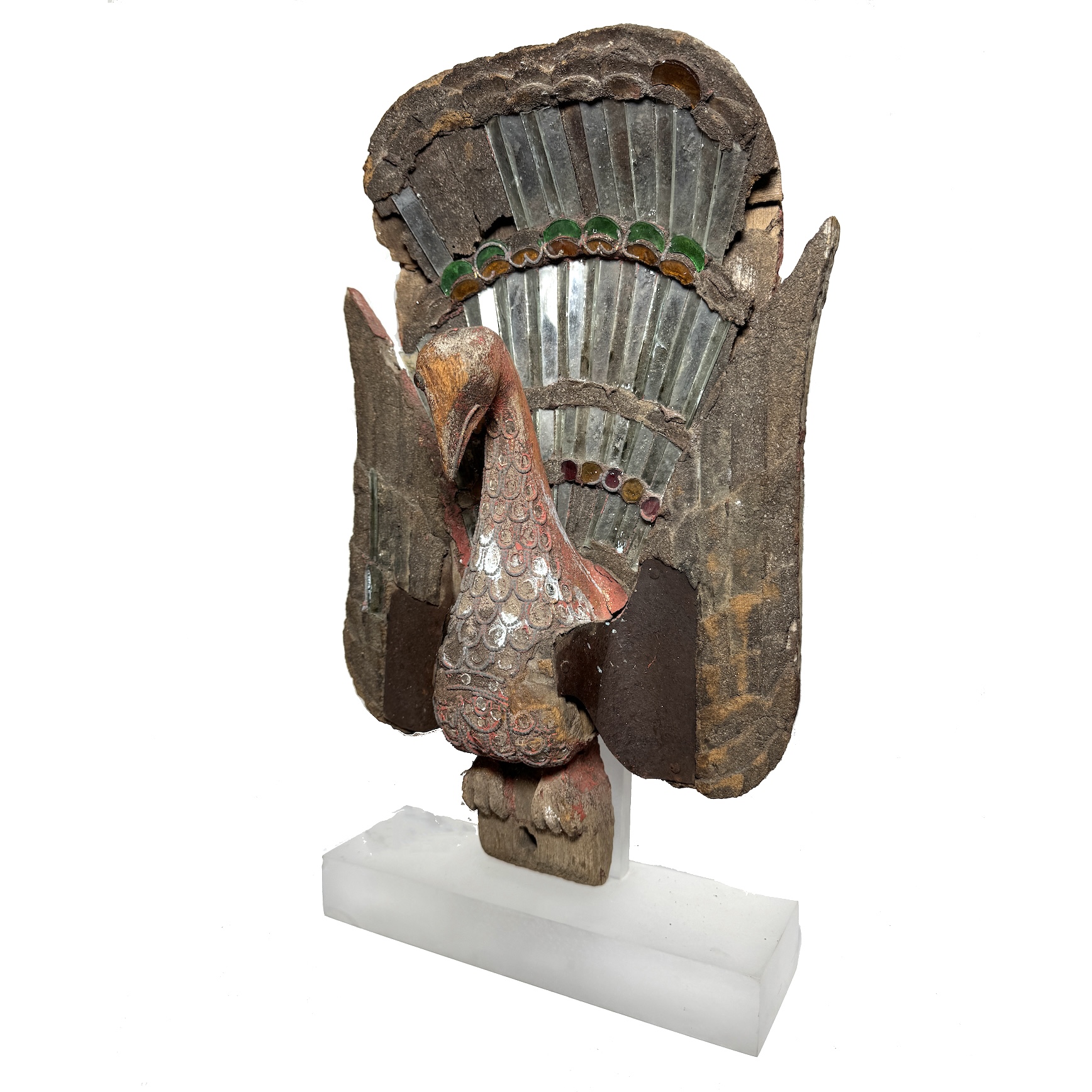


Antique Peacock with Inset Mirrors and Glass (3122) Burma/Myanmar
$875.00
H: 16.5” W: 9.5” | 2.875” : | CALL 213-568-3030 OR EMAIL VANISHINGARTS213@GMAIL.COM FOR SHIPPING.
Carved Mandalay style peacocks with outspread feathers like this were placed over entrances to protect religious and government buildings. The peacock was emblem of last Burmese Dynasty symbolizing the monarchy descending from the sun.
Description
The peacock is very significant in Buddhism, especially the Theravada Buddhism practiced in Burma. It is one of 108 images on the Buddha’s footprint and reflects the short-lived nature of all things, since it appears and vanishes as swiftly as it displays and furls its tail. It is believed that peacocks can eat poisonous plants without being affected and are considered synonymous with the great bodhisattvas who transform the poisonous mind of ignorance, desire and hatred into thoughts of enlightenment, which open colorfully like the peacock’s tail.
The Mahaparitta Pali Sutras (Buddhist scriptures in ancient Pali) reference the peacock:
“The great Being (the Buddha-to-be) was born a peacock,
fulfilling the necessary requirements for obtaining Enlightenment,
and having arranged protection for himself by means of this protective discourse
to freedom, and to those who had achieved freedom.
Having made this protection, that peacock rested happily at home.”
The peacock was the emblem of the last Burmese Dynasty, the Konbaung (1845-1941). Since the peacock represents the sun and is an emblem of the ruling dynasty, it symbolized the monarchy descending from the sun. The Burmese Peacock Dance relieves droughts caused by the sun, and sacrificing a peacock brings forth rain and the heavenly gift of fertility.
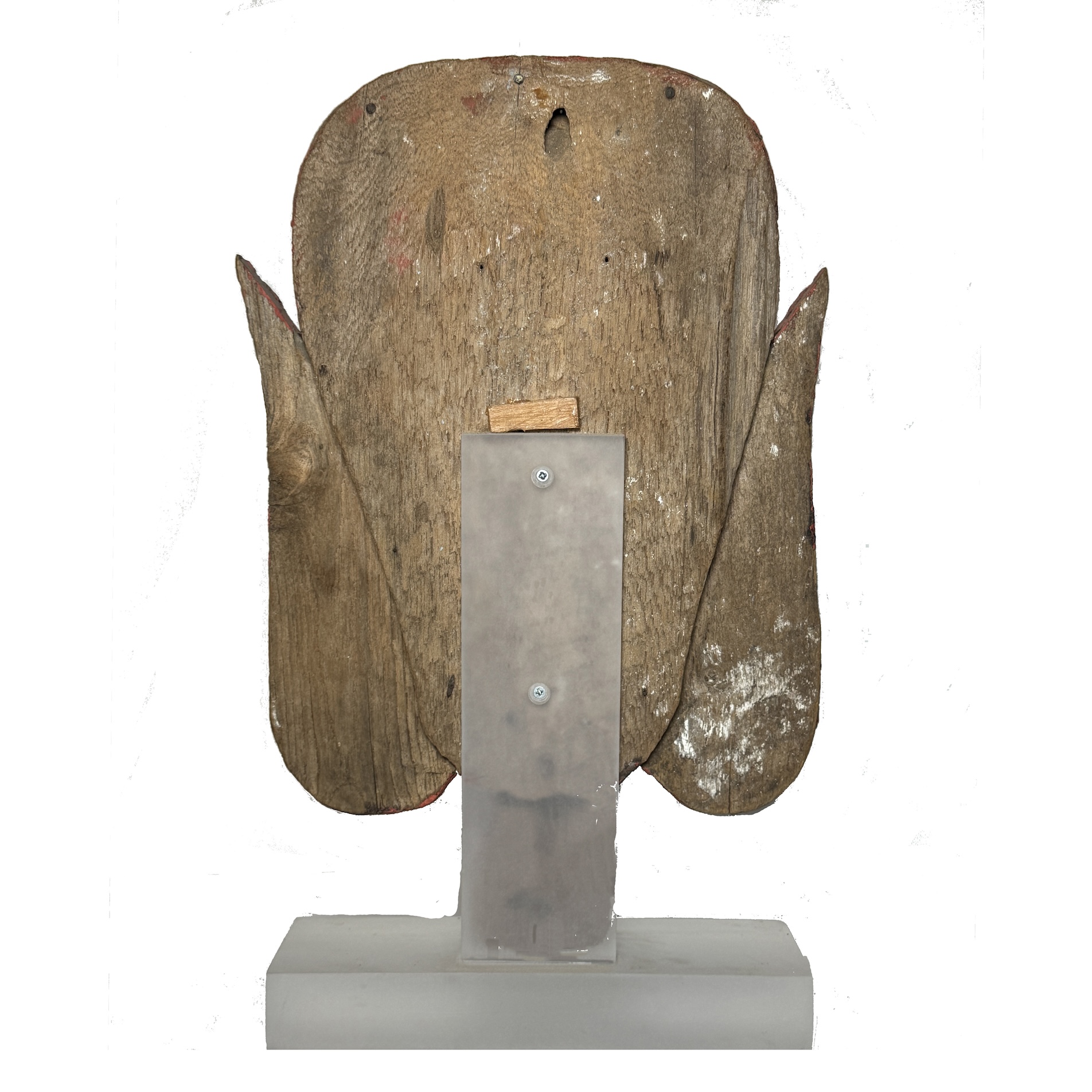
Hand-carved from a single thick plank of local teakwood, this large architectural fragment is a stylized peacock covered with the traditional a traditional Burmese decorative technique (Hmanzi Shwecha) in which colored glass is laboriously embedded in black lacquer relief. The multi-colored glass and mirrors replicate iridescent “eyes” of the peacock’s plumage. The reverse displays an authentic, heavily weathered wood with tool marks and aging , which indicates long exposure to a tropical outdoor climate.
The mortise/peg hole on the bottom under the claw suggests it was likely added as decorative feature to an architectural structure like a temple or monastery. Traditional Burmese monasteries and royal pavilions were adorned with expanses of external teakwood carvings as gable ends, eaves, and balustrades. The wings were attached by flat metal panels which have somewhat corroded over time. It is in remarkably good condition with some expected deterioration of wood, faded paint and glass and mirror losses as it was routinely exposed to monsoon rains and intense tropical sun.
Effects of age and outdoor use all which add to its folk art warmth and charm although making it somewhat fragile. It is mounted on a frosted Acrylic base.
AI Market Valuation Summary
AI rates this piece as Mid-Tier Collectors Value for the following reasons:
Its displays considerable evidence of authenticity. The traditional Hmanzi Shwecha technique, which involves coating carved teakwood in layers of black lacquer and meticulously embedding colored glass or mirror fragments is a demanding, highly specialized historic art form that modern reproductions cannot replicate. The hand-planed tool marks, age-related oxidation of the wood, and natural shrinkage or weathering visible on the reverse help verify its age and use. After the Anglo-Burmese wars and the fall of Mandalay in 1885, much traditional folk and courtly artwork was dispersed, destroyed, or taken out of the country and authentic 19th-century sculptural items are scarce on the open market.
Additional information
| Place of Origin | Burma/Myanmar |
|---|---|
| Period | Antique, Mandalay Period (1883-1885) |
| Materials and Technique | Wood |
| Dimensions (inches) | H: 16.5” W: 9.5: D: 6.5” |
| Dimensions (metric) | H: 41.9cm W: 24..1cm D:73cm |
| Item Number | 3122ASC |
| Date | 19-20th Century |
| Condition | Good to fair, see description |
| Shipping Box Size | Oversized. Call 213-568-3030 or email vanishingarts213@gmail.com for shipping. |