
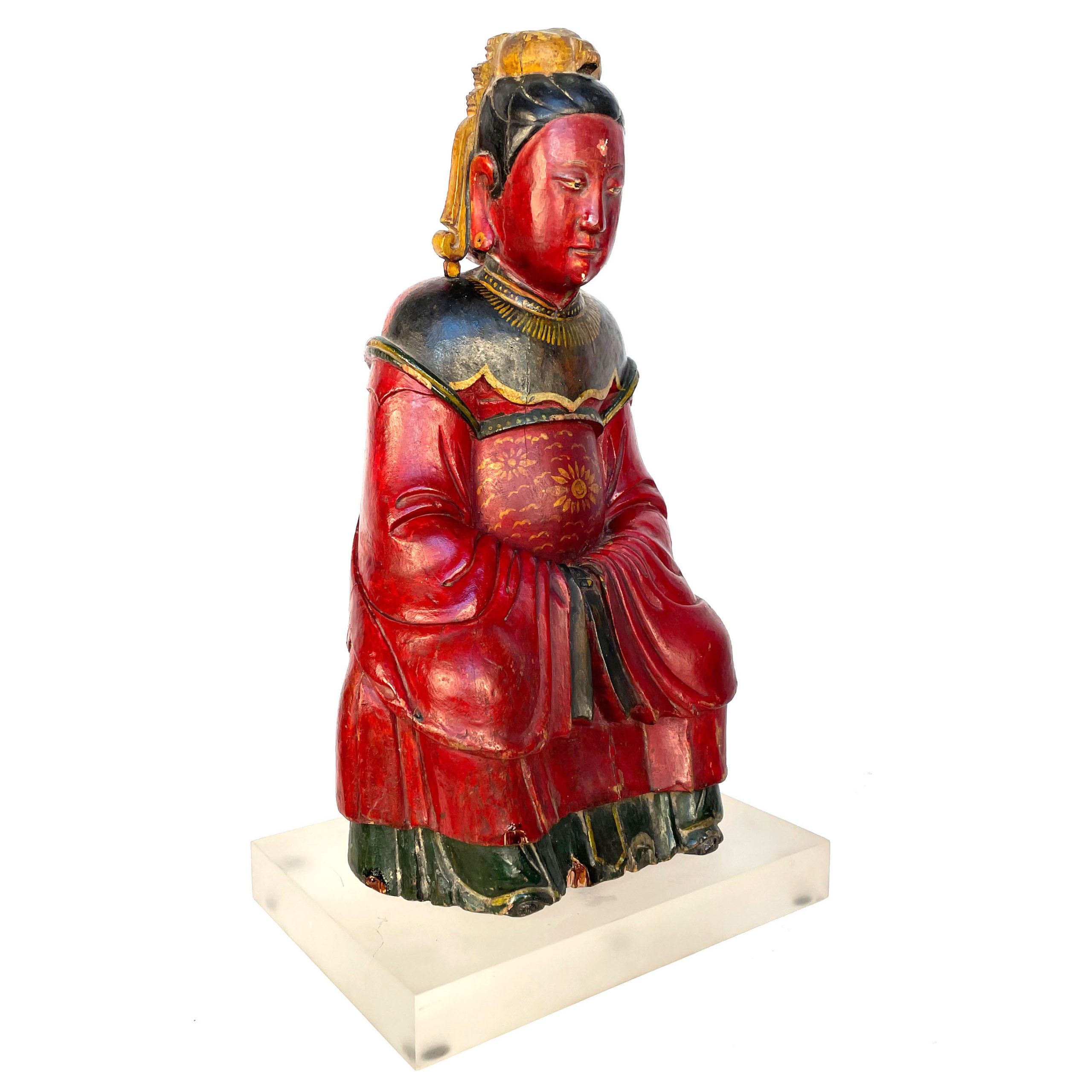
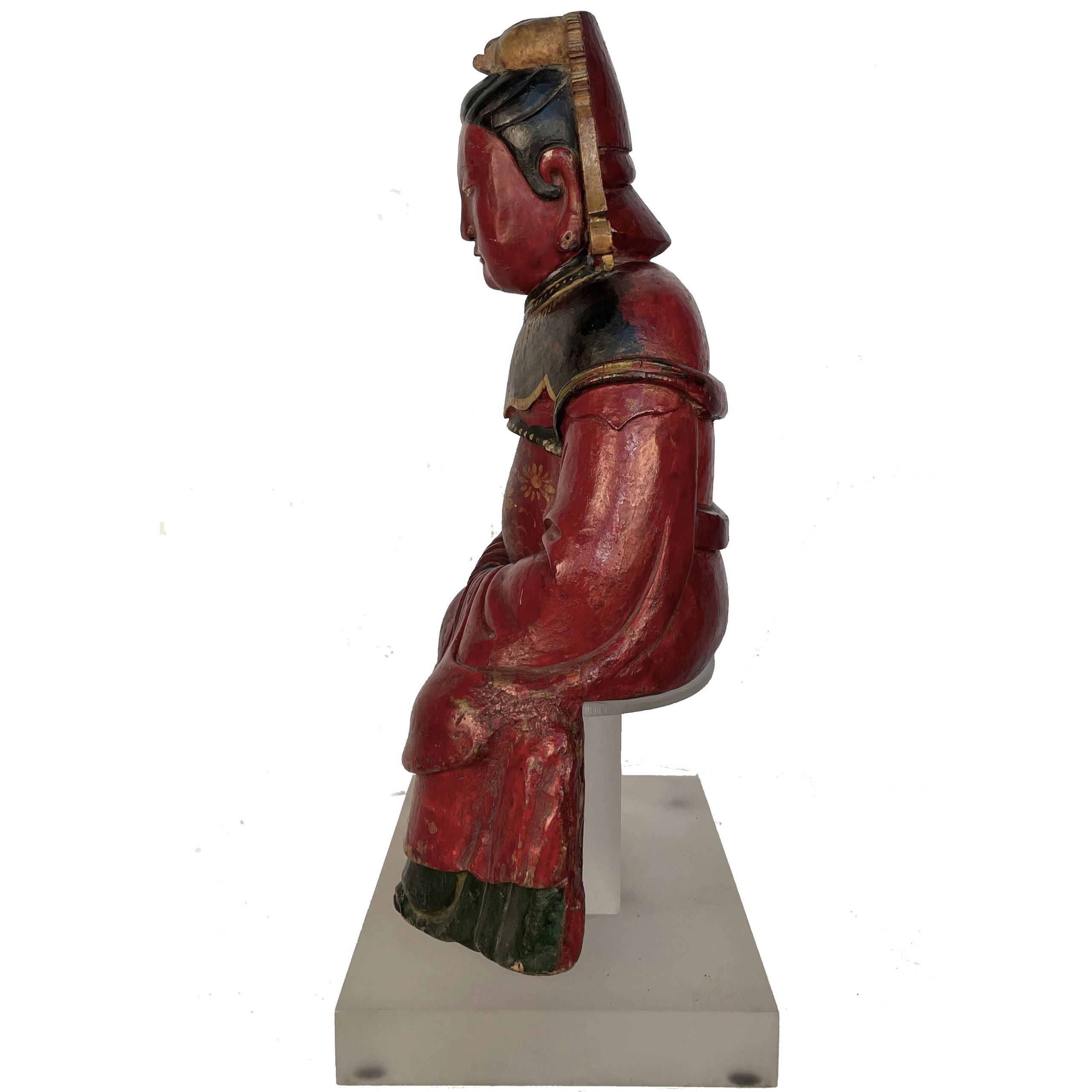


Antique Heavenly Taoist Empress Mazu on Lucite Stand, China (5677)
$2,100.00
H: 21” W: 11.5” D: 8” | FOR SHIPPING call 213-568-3030 or email Vanishingarts213@gmail.com
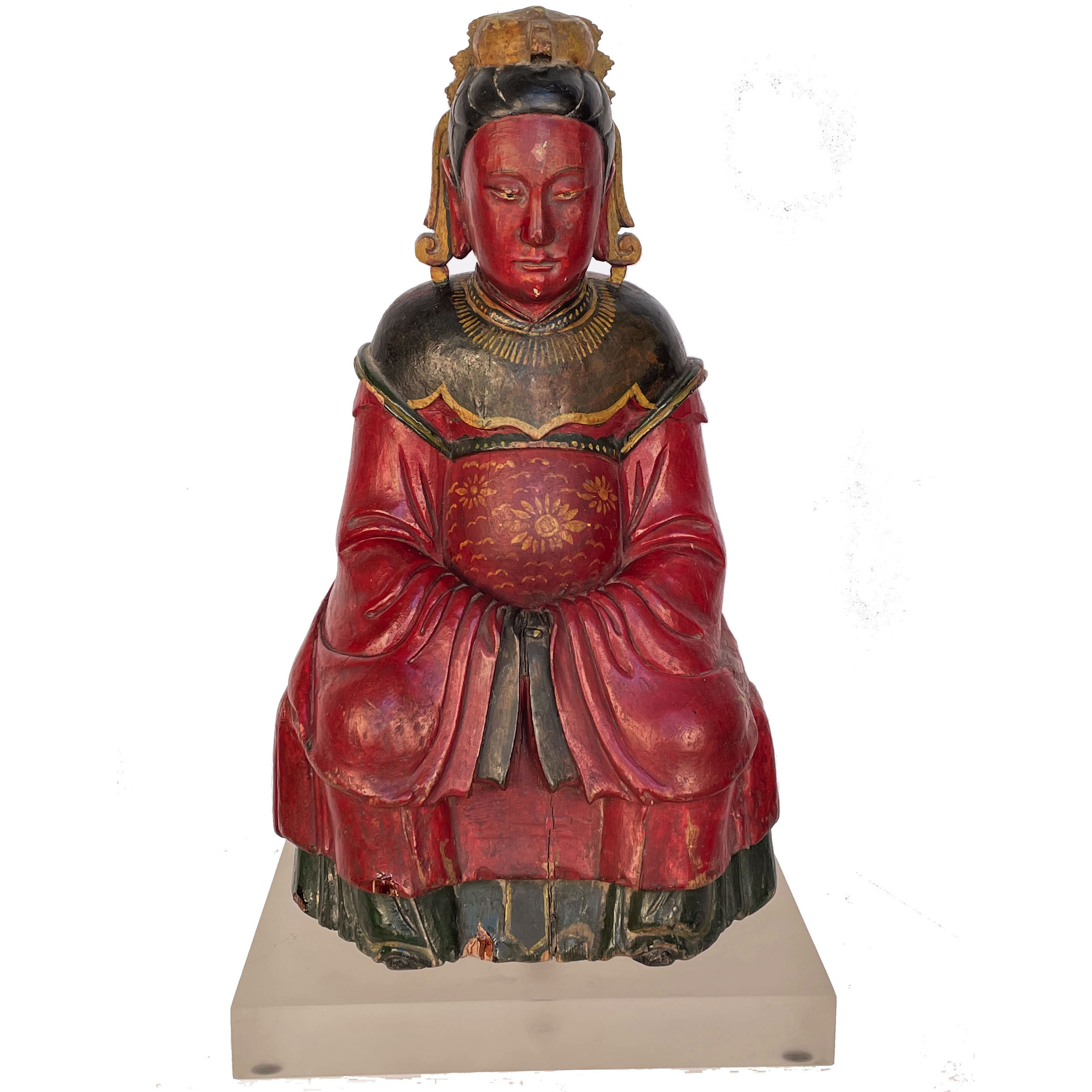
Temples for “Heavenly Empress” Mazu in southern China coastal regions protect sea faring peoples. This motherly home altar statue reflects that although childless, she protects her children – her devotees – as a mother. Seated on lucite base.
Description
Mazu (Matsu) is the Goddess of the Sea who protects seafaring populations and coastal populations and a tutelary deity venerated as the “Protector of the Sea.” A syncretic deity, she embraced by all Chinese peoples, in written traditions of the imperial Chinese hierarchy who officially deified her and built sanctioned monuments and temples to her since the Song Dynasty and in oral traditions by masses who follow her in Taoist, Buddhist, and Popular Religion traditions. Although Mazu is generally considered Taoist, Guanyin is believed to have been very devoted to Mazu and some believe she was incarnated as Mazu. After visiting a Guanyin temple as a child she became a devout Buddhist. Her association with the provincial Empress of Heaven tradition is strongest in southern China coastal regions, Hong Kong and Taiwan where community temples were built called Mazu Temples or Heavenly Empress Taoist Halls.
Mazu images were and still are created for clan, temple or a home altar where she is portrayed as matronly and motherly, reflecting the belief that although she was childless, she protects her children – her devotees – as a mother would. In these regions she is affectionately called Ma Tsu P’o, which translates as “Mother”, “Granny” or “Grandmother,” and “Auntie Lin. In Popular Religion belief, devotees never pray to her using her formal name since if she is called by one of her formal titles such as “Empress of Heaven,” she would feel compelled to dress formally which would delay her response. Identified by Irvin as one of the Great Chinese Goddesses she is a universal deity who epitomizes the feminine role of compassionate protectors and grants health, long life and safety to all devotees regardless of their class. Three ornamental flowers painted on her stomach might reflect the Popular Religion myth that when Mazu’s mother was pregnant, she prayed for a daughter as she already had six sons. In a dream Guanyin gave her a flower blossom to wear, and the next day Mazu was born.
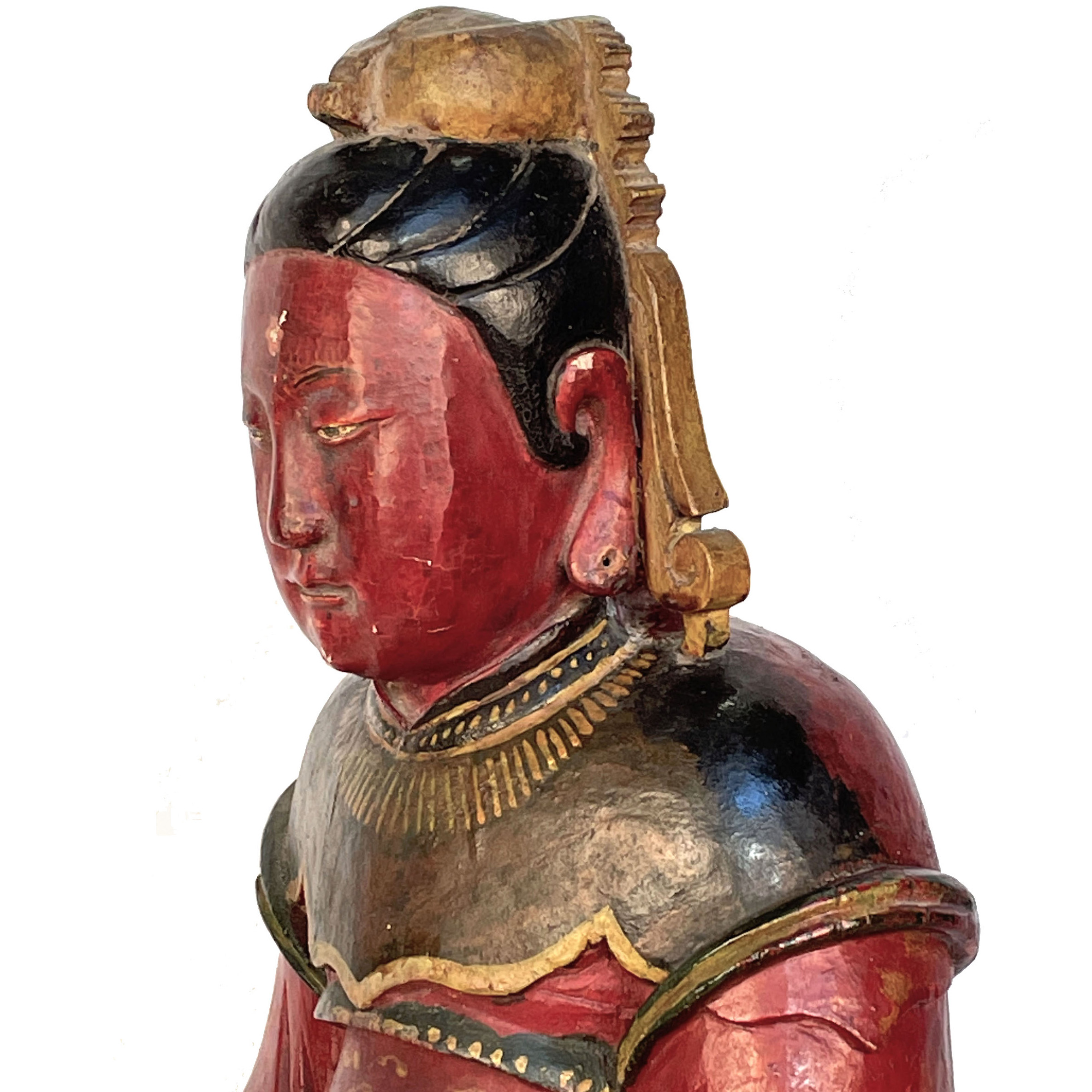
The refined features and graceful proportions of this elegant carving transform it from a folk-art carving to a piece of fine religious sculpture. Her elongated auspicious earlobes indicate her status as a wise and enlightened being. She wears her iconic attire: rich red imperial robes with flowing black lined sleeves, scalloped black and gilt formal cloud collar, and a central roundel on the front with a highly detailed, delicate gold-gilt painted solar/floral motif. This traditional Chinese cloud collar is portrayed as a symbolic ruyi cloud pattern that radiating outward around her neck The ruyi symbolizes heavenly blessings, longevity and harmony and flow of vital energy and indicates her high celestial rank. .Mazu is often dressed in red so travelers at sea can easily spot her if they need assistance. Her sleeves conceal her hands clasped at her waist, a common pose for Taoist deities. Her hair is pulled under her identifying feature, a prominent imperial headdress topped with a phoenix. The statue’s extraordinarily large size is rare and indicates it was probably placed in a temple rather than home setting.
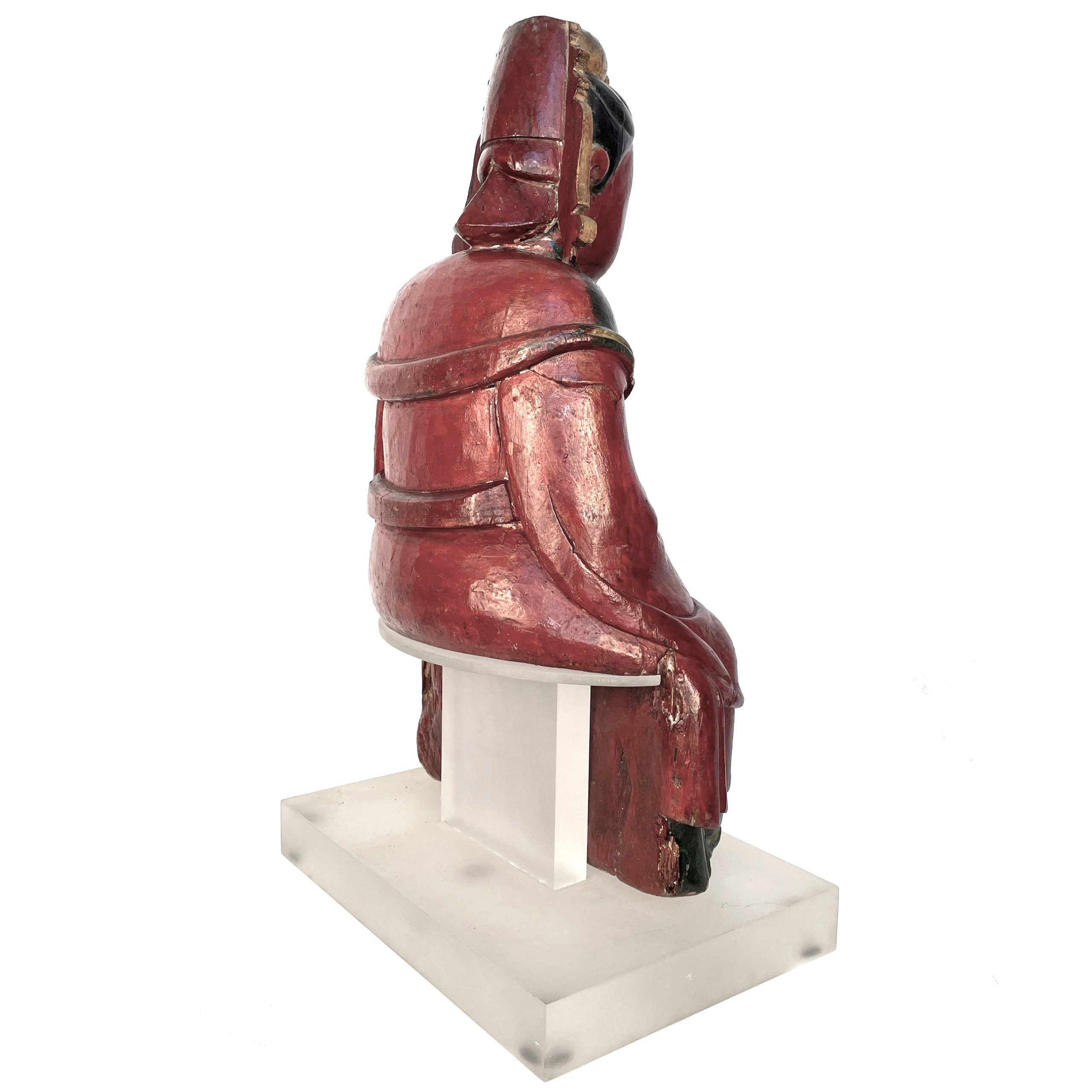
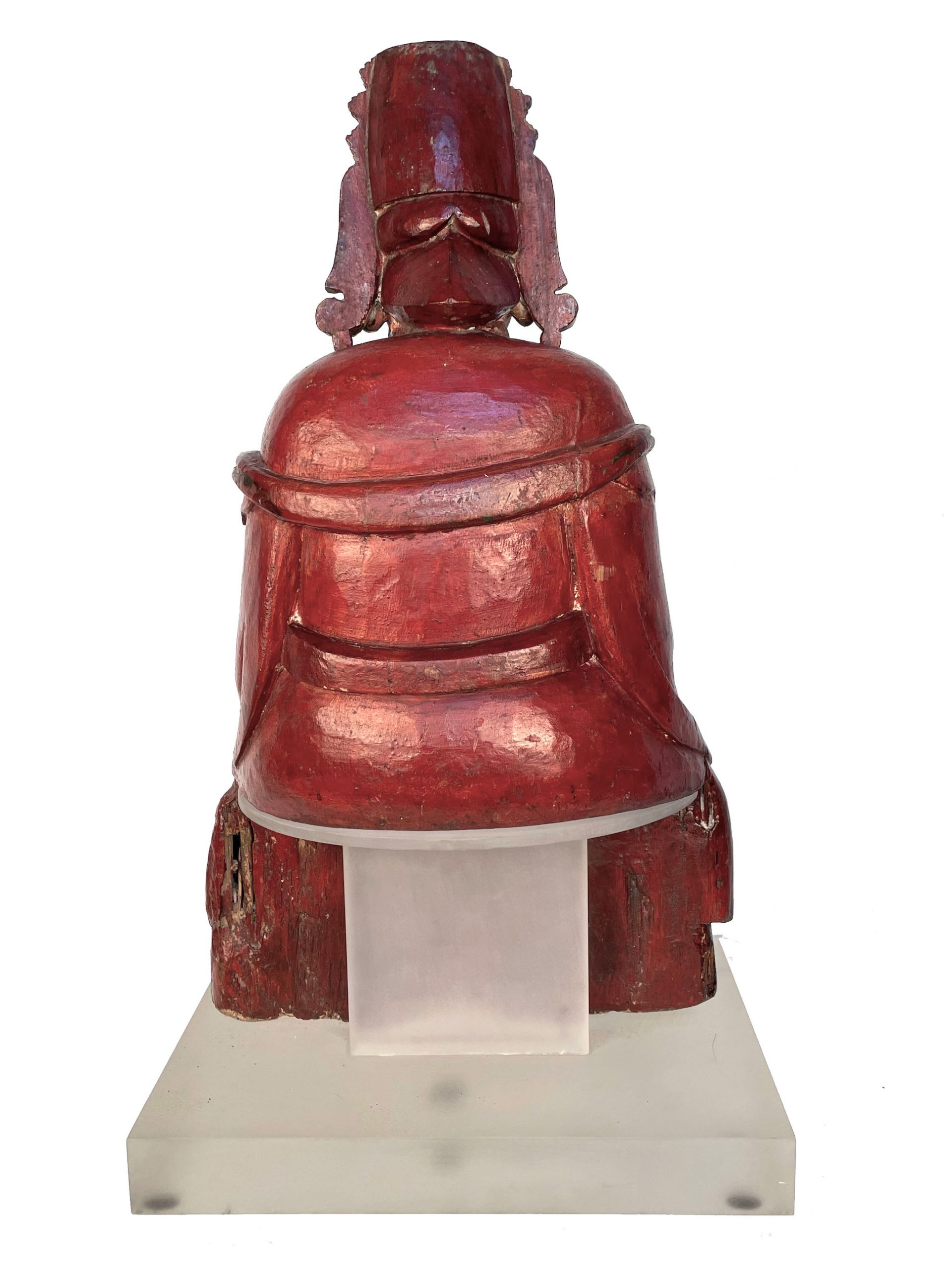
This piece is wonderfully carved and is in excellent condition with exception of some lacquer losses. She originally sat on a detached throne that is now replaced by an acrylic base.
AI Market Valuation Summary
AI rates this piece as Exceptional,Premier Tier Collectors Value for the following reasons:
The masterful presentation and highly refined craftsmanship is typical of workshop quality pieces rather than village folk art. The sensitive and skilled craftsmanship on the statue’s front and back is seen in the flowing lines and elegant contours of the heavy robes, detailed hair and elegant headdress. Unusually large in size and of the exceptionally high quality level, it was likely placed in a clan or community temple. The red lacquer has a beautifully aged, web-like texture, light surface oxidation and gentle degradation indicates decades of exposure to ambient temple smoke and natural temperature shifts, confirming genuine age. The professional mounting ensures the large heavy sculpture remains stable and secure for long-term display.
Sources:
Lee Irwin, “Divinity and Salvation: The Great Goddesses of China,” in Asian Folklore Studies, Indiana University, Vol. 49, 1990, pp 53-68. Claudia Monique, “Matsu/Mazu Goddess of Sea,” May 20, 2014.
Additional information
| Period | Antique, Qing Dynasty |
|---|---|
| Date | Late 19th/Early 20th Century |
| Materials and Technique | Wood |
| Dimensions (inches) | Ht: 21” W: 11.5” D: 8” |
| Dimensions (metric) | Ht: 53.34cm W: 29.21cm D: 20.32cm |
| Weight | 14 lbs 7 oz |
| Condition | Excellent, age appropriate signs of wear |
| Item Number | 5677JACK |
| Shipping Box Size | Oversized. Call 213-568-3030 or email vanishingarts213@gmail.com for shipping. |