


Antique Official Holding Belt of Office, China On Lucite (16470)
$525.00
H: 10.3″ W: 6″ D: 3.5″ | FREE SHIPPING IN CONTINENTAL US
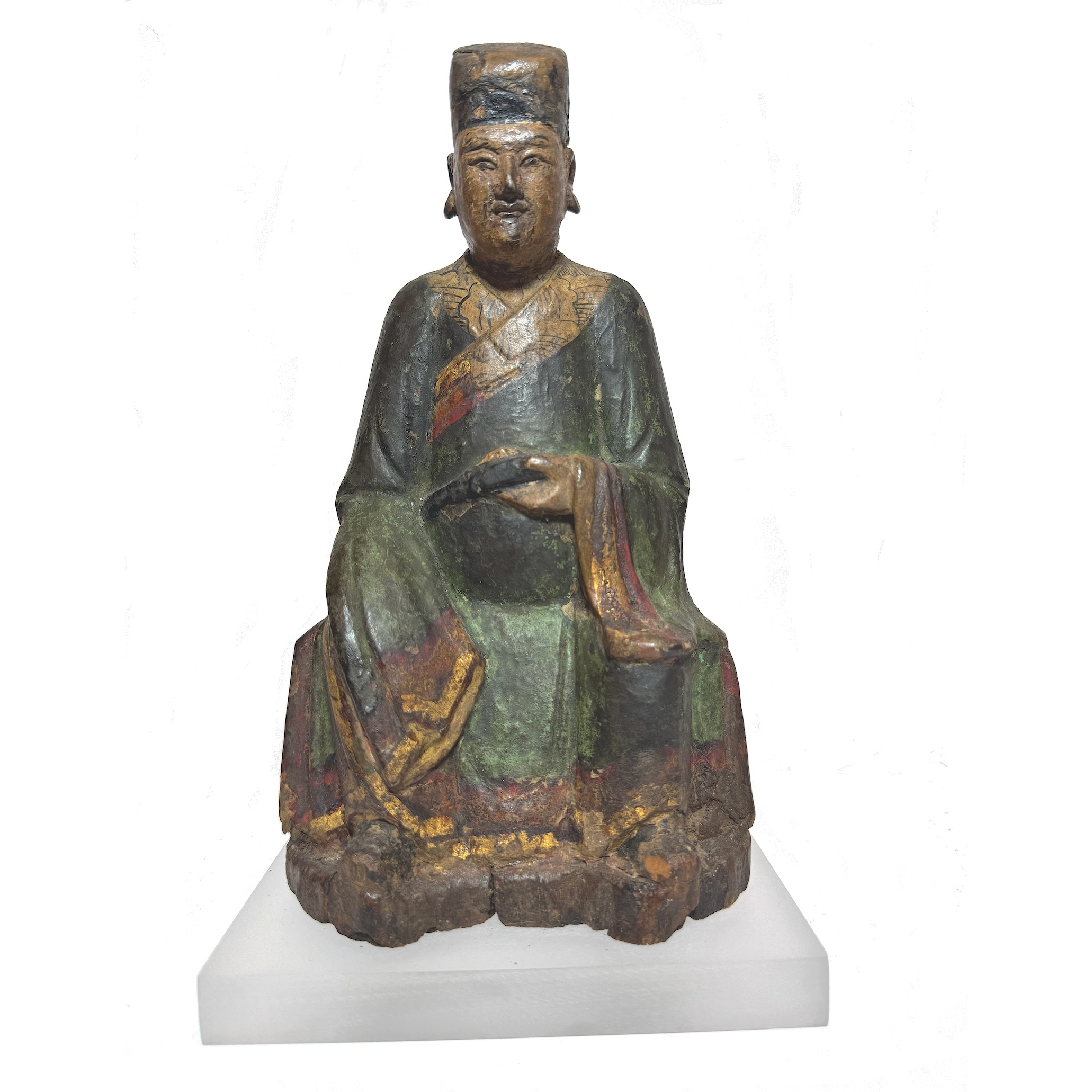
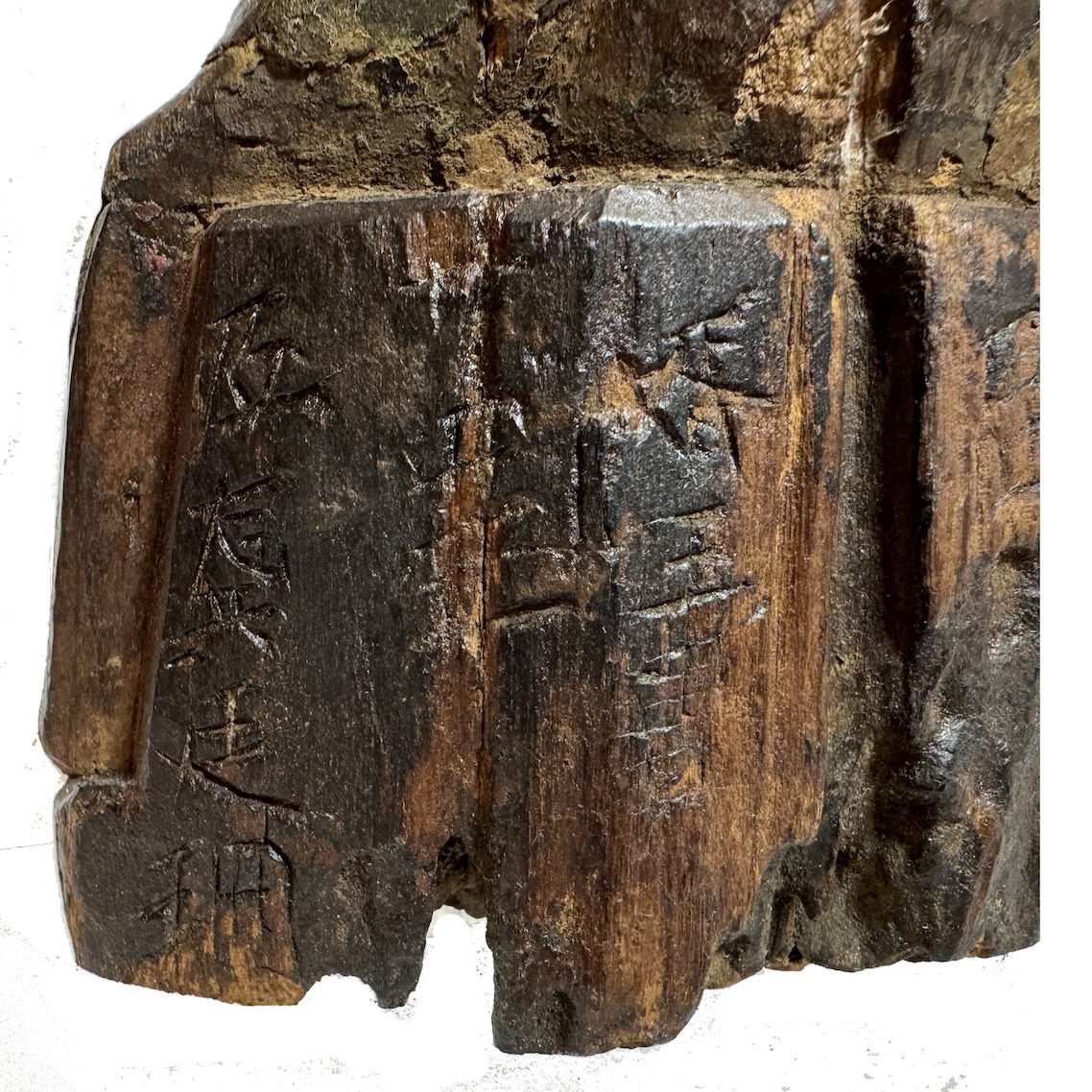
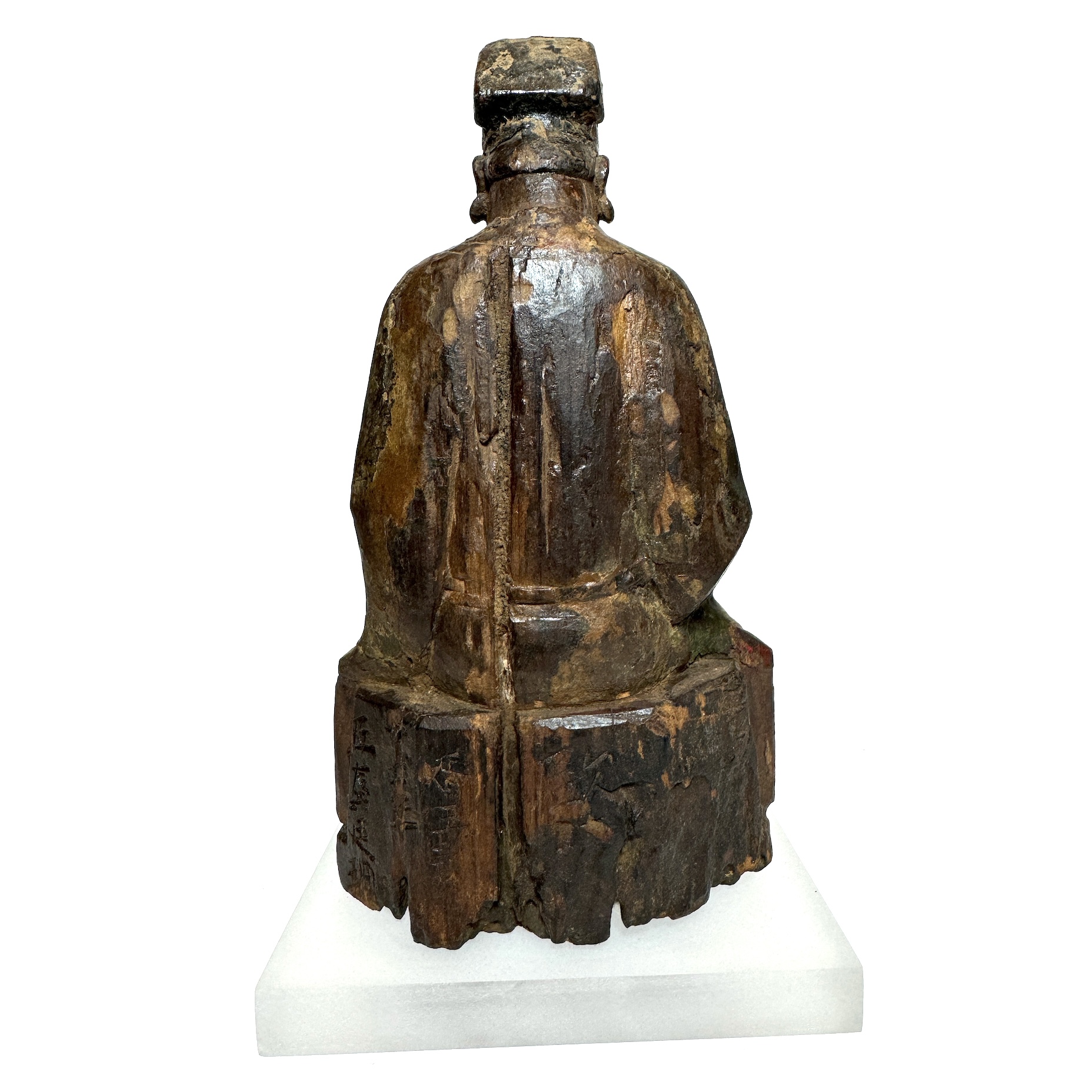
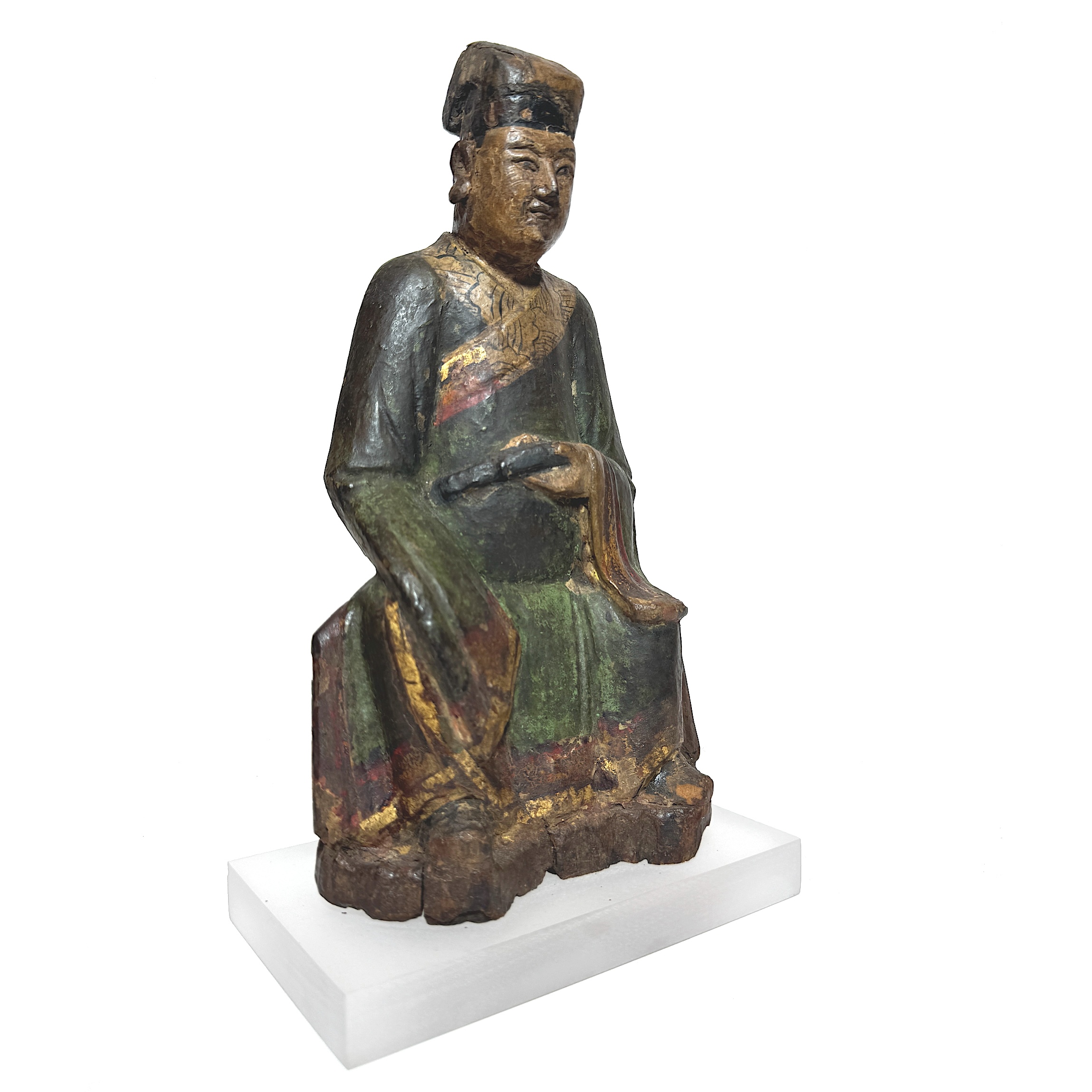
Mandarin ancestor official in court attire and hat holding up his belt of office. Rare consecration inscriptions on the back indicate the names of two families who pooled funds to commission, carve, and dedicate a sacred figure to their shared local temple or ancestral altar.
Description
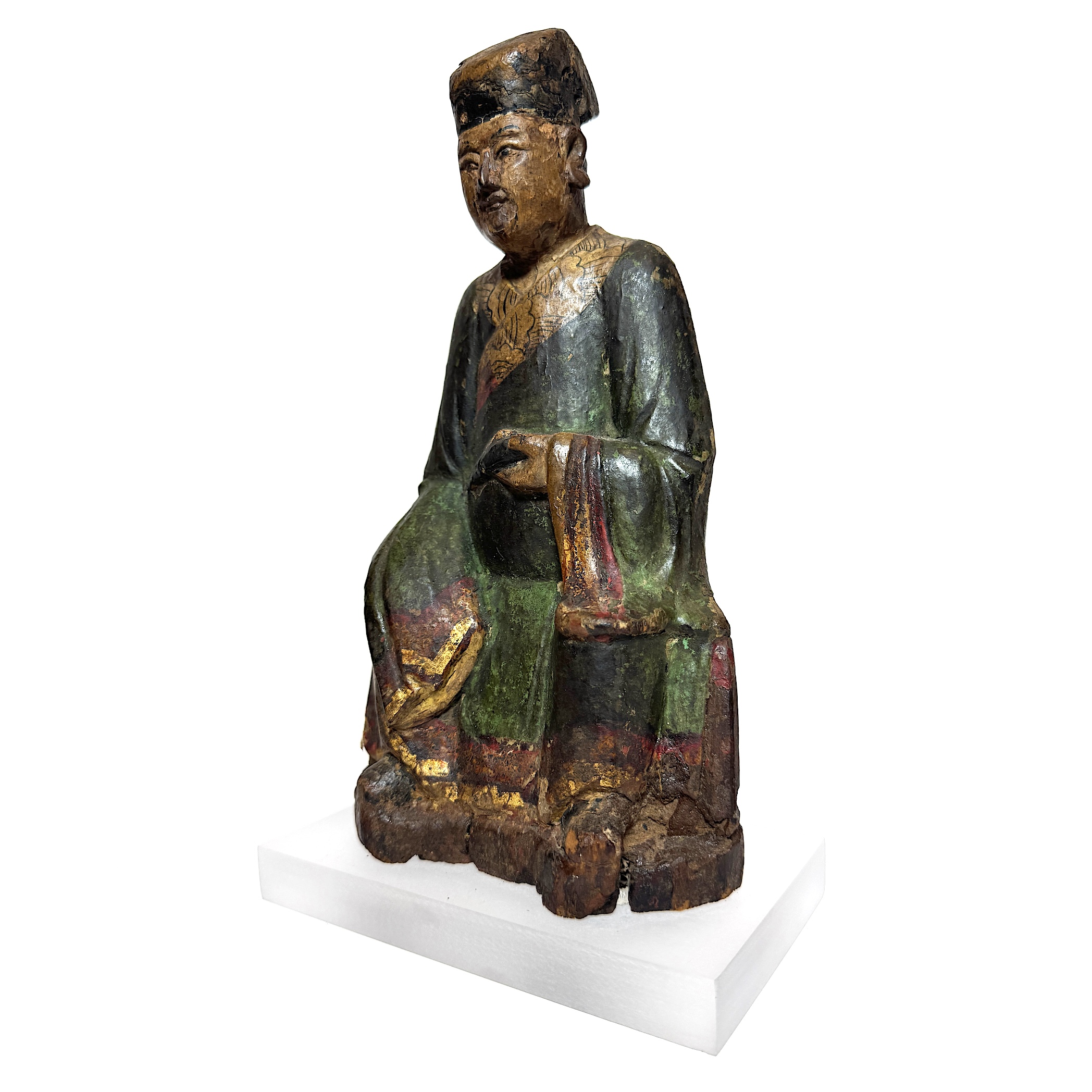
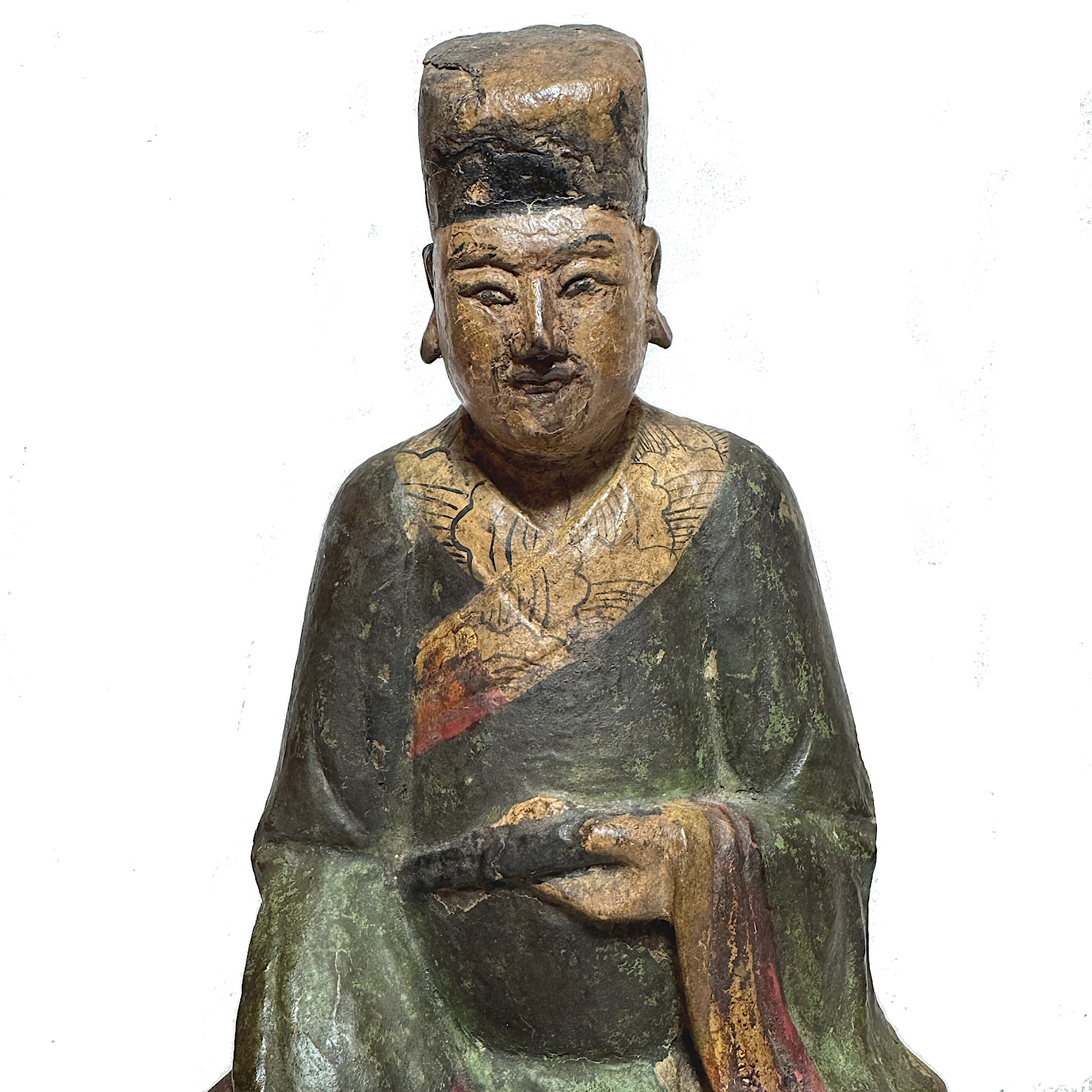
This brightly painted idealized Ming/Qing Mandarin high-ranking bureaucrat or scholar was made for a home altar on a backless chair in traditional official’s pose and attire, feet firmly planted on a pedestal. He sits in standard formal, symmetrical frontal posture to emphasize dignity, control and readiness to serve. His serene, aged facial features, and painted remnants of a mustache and beard is a nonspecific generalized depiction. His expressionless composure reflects his high rank and detachment from worldly pursuits.
His left hand holds up his belt of office to show his high status and the right is over the knee obscured by his long flowing robe. He wears an official’s hat. His extremely well-defined face is highlighted with painted eyebrows and pupils inside deeply carved lidded eyes. His green robe extends to his boots, extremely costly items of status worn only by those who could afford them.
His elegant mandated “power robes” – full-length, straight-collar, fastening on the side – and official’s hat validated his role as a strong protector and benefactor. The green, red, and black elegant robes indicate he is a middle-rank official and are embellished on the collar with painted cloud forms and red and gilt borders on the sleeves and hem. One hand holds up his belt and the right rests over the knee in a balanced symmetrical composition. Belts were status symbols since ancient times, and holding one made the ancestor’s rank and status indisputable.
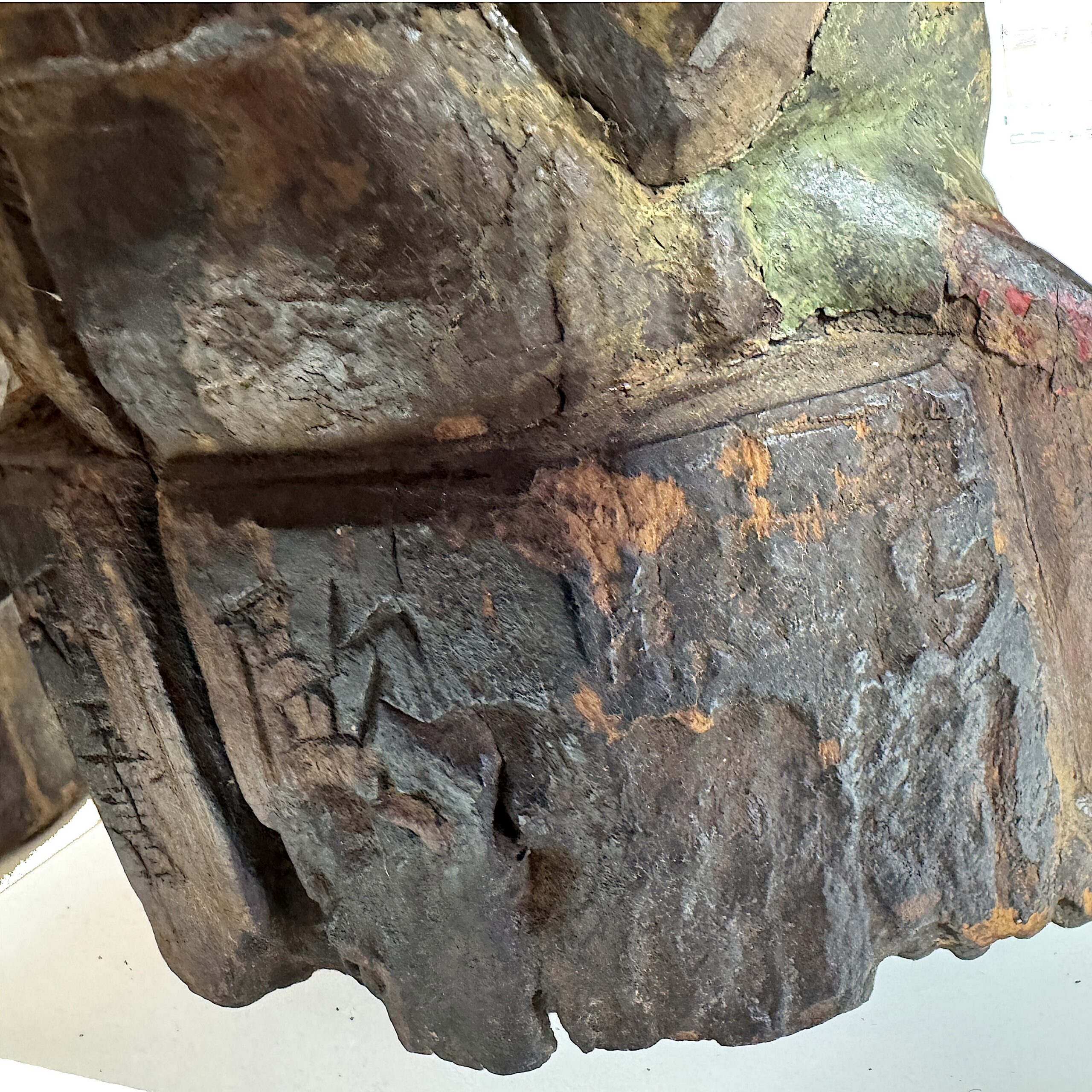
The deeply incised character on this piece are its most significant attributes in terms of identification, collectability and market value. The incised character on the left side is the Ou family (歐府)and next to it is the Zhang family (張府) indicating the statue was a collaborative religious offering of the families to commission, carve, and dedicate a sacred figure to their shared local temple or ancestral altar. The calligraphic strokes below the names are remnants of a standard consecration or prayer formula which typically used phrases like “respectfully offered” (敬奉), “repaying a vow” (酬願), or “accumulating merit” (功德).
In very good condition, much of the original pigment and gilt remain with expected minor losses, cracks and chips normal for its age and use. The thick, visible layers of green, red, and black lacquer combined with remnants of gold leaf indicate a very high state of preservation for regional folk art. It is mounted on a frosted acrylic stand. It is a colorful and masterful piece of history.
AI Market Valuation Summary
AI rates this piece as Advanced Collectors Quality Value for the following reasons:
The condition of this carving is superior for a piece of this age and, based on its surface, is clearly authentic 17-18th century. The accumulation of century-old incense smoke, soot, and airborne oils cannot be replicated artificially The fibrous grain is split along natural growth lines, proving the wood has expanded and contracted genuinely over generations of seasonal temperature shifts. The patina also verifies it age and authenticity with a deep, heavy accumulation of dark incense soot near the carved grooves of the text contrasts beautifully against the honeyed, oxidized tones of the bare wood underneath. It has retained most of its original layered naturally derived pigments of vibrant cinnabar reds and malachite greens. The bright red and gold pigment along the top of the base block indicates that the robes were completed after or alongside the base’s construction, confirming the entire structure is completely integral. Collectors heavily favor pieces that associate the carving of an ancestor to a specific families or regional clans like this that was placed on a significant shared. ancestral altar or local temple. It is highly commercial because of its ideal 11-inch “cabinet size.” on a custom Lucite base ifor modern collectors to display prominently.
Additional information
| Weight | 1 lbs |
|---|---|
| Dimensions | 14 × 10 × 6 in |
| Place of Origin | China |
| Period | Antique, Qing Dynasty |
| Materials and Technique | Wood |
| Date | 18th century |
| Dimensions (inches) | Ht: 10.375" W: 6.125" D: 3.5" |
| Dimensions (metric) | Ht: 56.51cm W: 18.41cm D: 22.581cm |
| Weight | 1 lb |
| Shipping Box Size |