
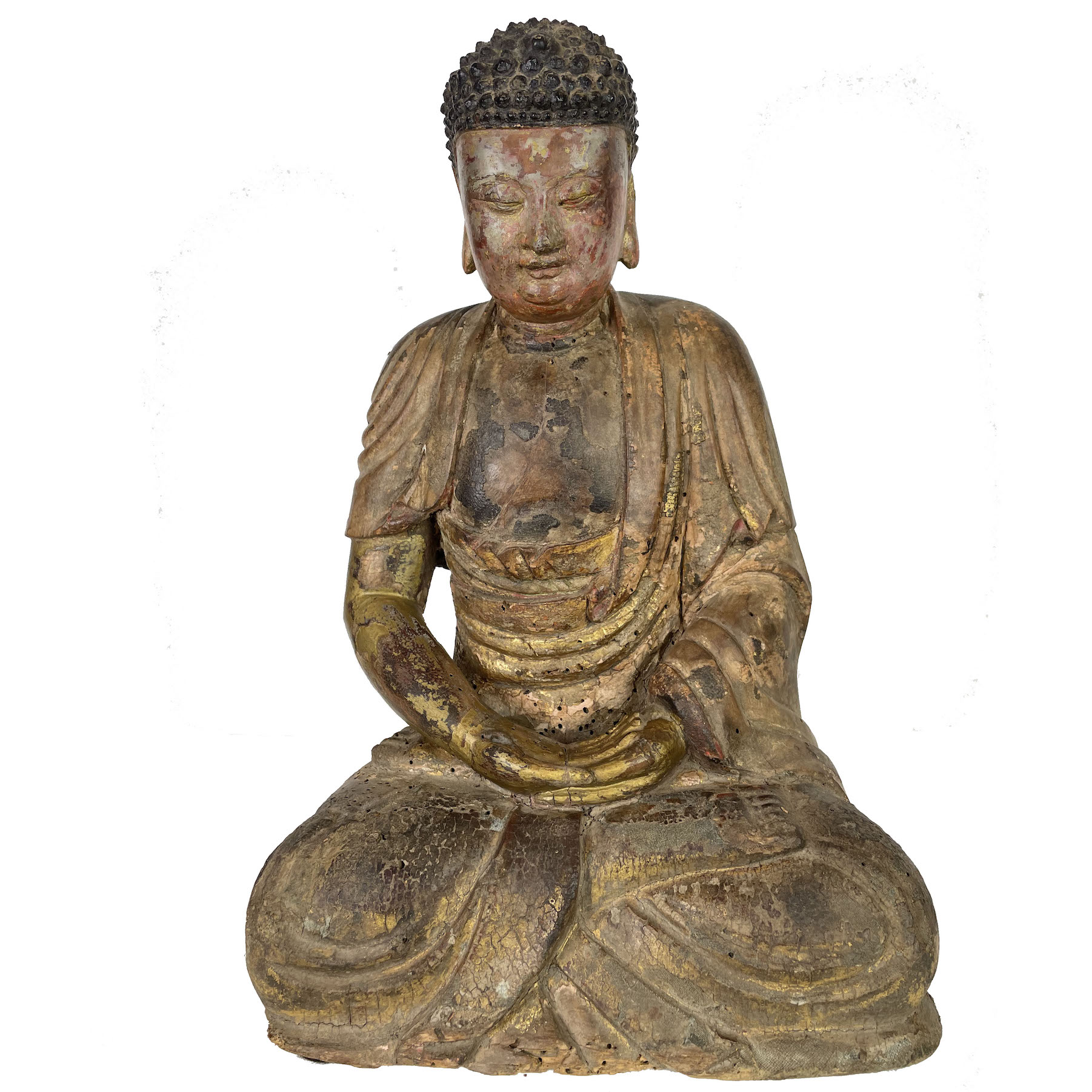
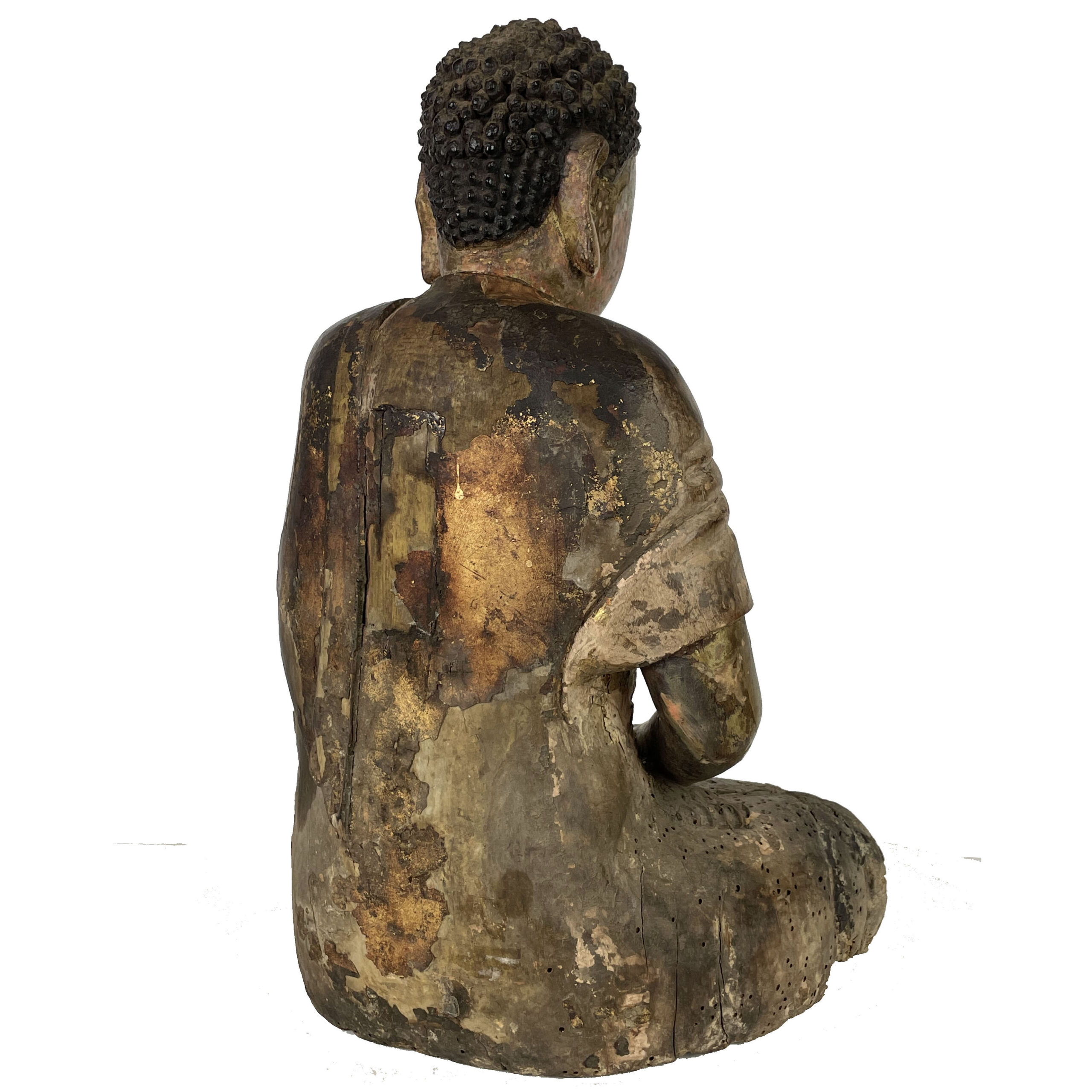
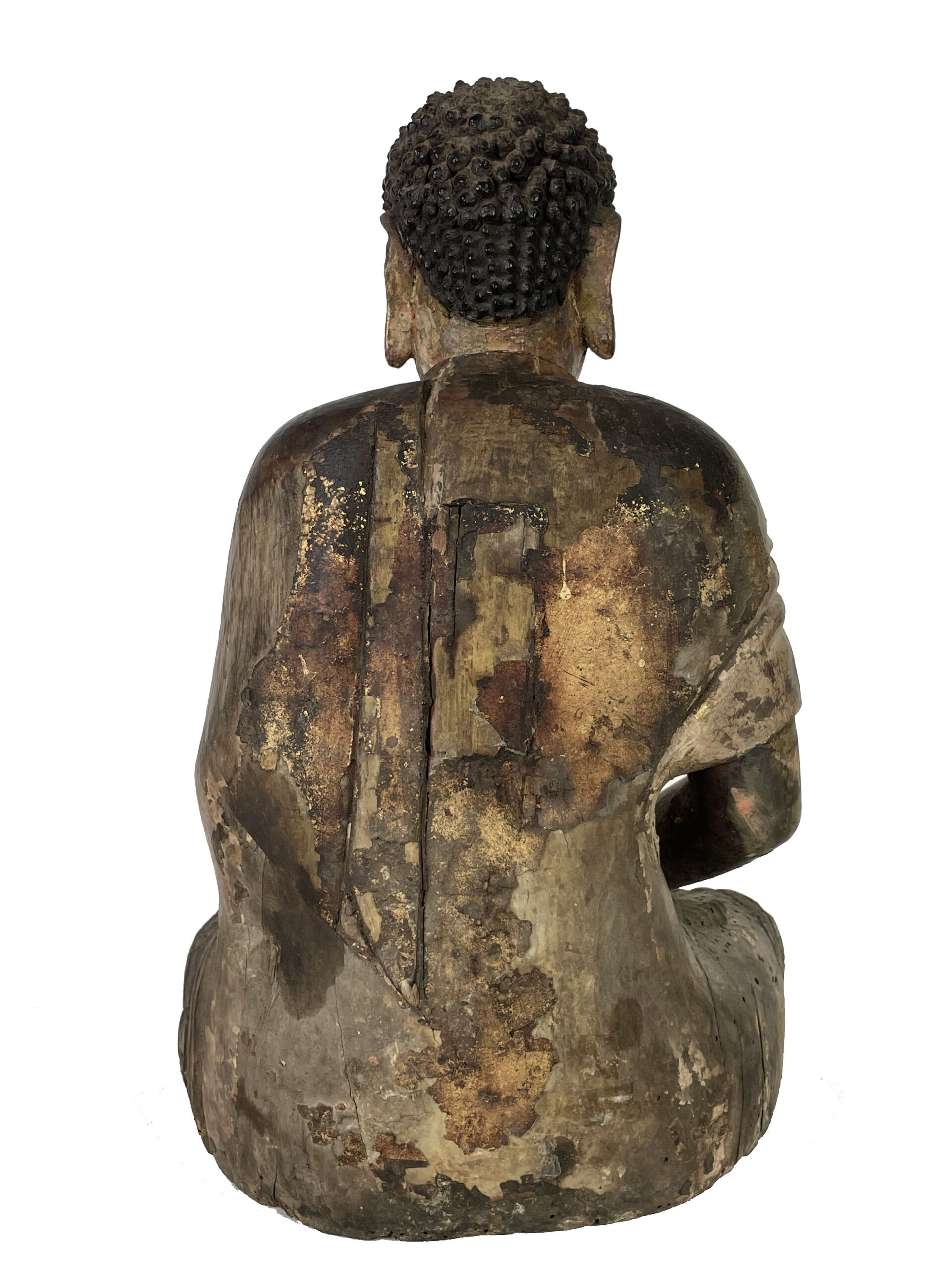
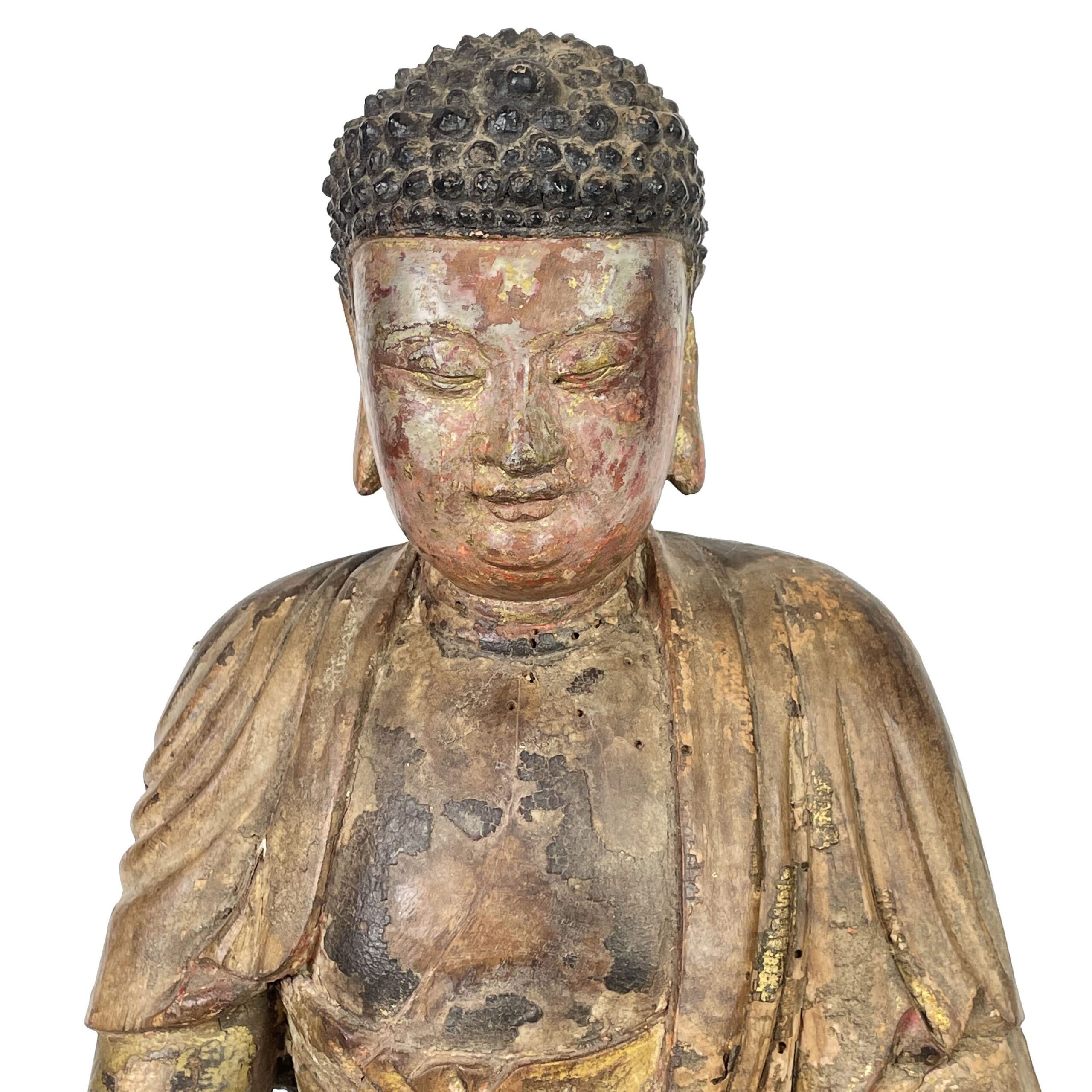
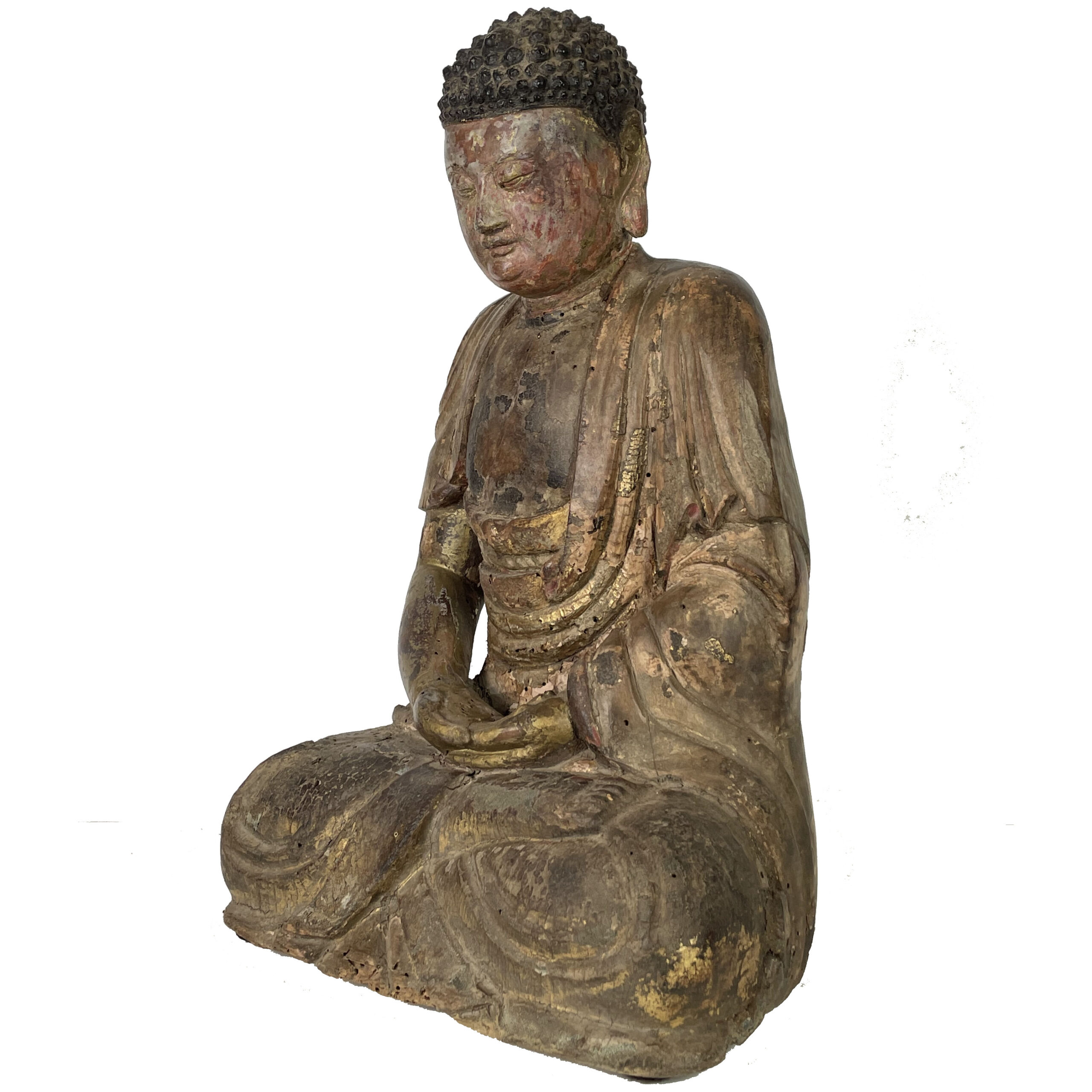
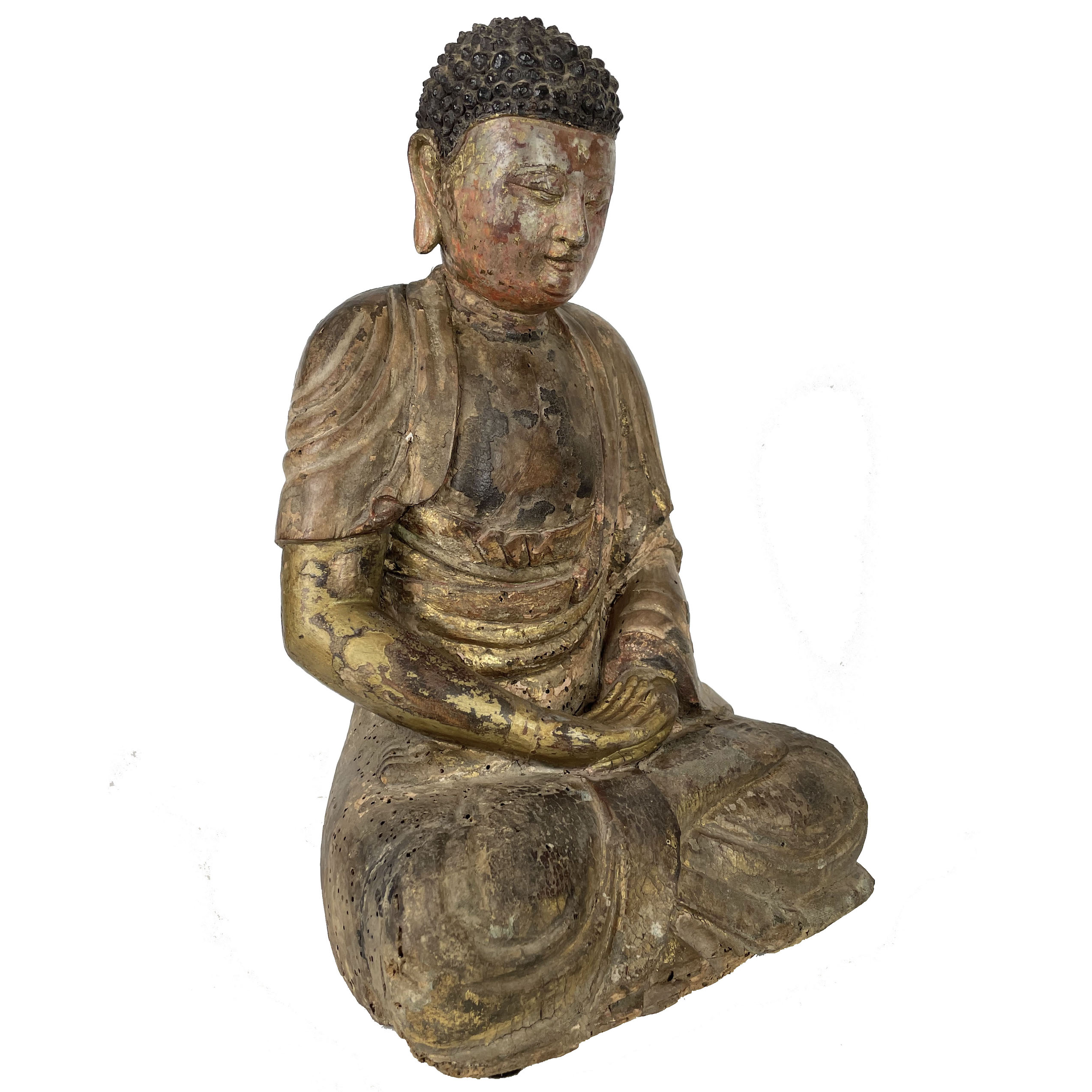


Ming Rare Carved Buddha in Meditation, China, (16089)
$3,600.00
H: 14” W: 9.375” D: 7.25” | FOR SHIPPING INFORMATION CONTACT US AT 213-568-3030
Rare small yet majestic Ming carving of the Buddha in meditation with gracefully draped robes and beautifully idealized features that radiates serenity, compassion and spirituality. A truly magnificent piece.
Description
Although there have been countless Buddhas, Buddha Shakyamuni is the only historical figure who lived on earth and was the source of teachings that became the Buddhist doctrine (the dharma). This piece is a classic painted, gilded, lacquered, carved wood statue of him dating from the late Ming to the early Qing Dynasty in the 17th or 18th Century.
The Buddha sits in the meditation position (dhyanasana) denoting perfect physical and spiritual balance. The hands rest on top of each other in his lap facing up in the position of meditation (dhyana mudra), the gesture of deep concentration and absolute serenity. The legs are crossed with one bare foot shown faced up in padmasana. This is the posture he assumed under the Bodhi tree before his enlightenment, and it is the most commonly used Mahayana Buddhist pose in the Ming/Qing dynasties symbolizing his profound state of inner peace, wisdom, and compassion.
Ming dynasty wooden Buddhas are known for their voluminous, naturalistic forms, stylized features, and elegant flowing robes. Here he wears a traditional simple, gracefully-carved three-part monk’s robe with a shawl covering his shoulders and back. His idealized, perfected, and symmetrical facial features include a square jaw, downcast heavy eyelids, and a blissful smile attesting to his status as a divine spiritual being.
He is portrayed with the identifying characteristics of the Buddha referred to in written cannons called lakshanas. The three neck creases represent luck, and the Buddha’s voice, the power and purity of his teachings, and also the three Buddhist fundamental traditions – conduct, concentration, and wisdom. The ushnisha, the raised cranial protuberance atop his head, denotes his seat of intellectual powers, wisdom, and divine energy. A bump in the ushnisha called a nikkeishu in Japanese is a jewel radiating the light of his wisdom. His head is “snail-crowned” with raised spiral curl knots recalling the time he was lost in meditation under the Bodhi tree on a very hot day and snails, in gratitude for his love for sentient beings, formed a protective hood over his head.
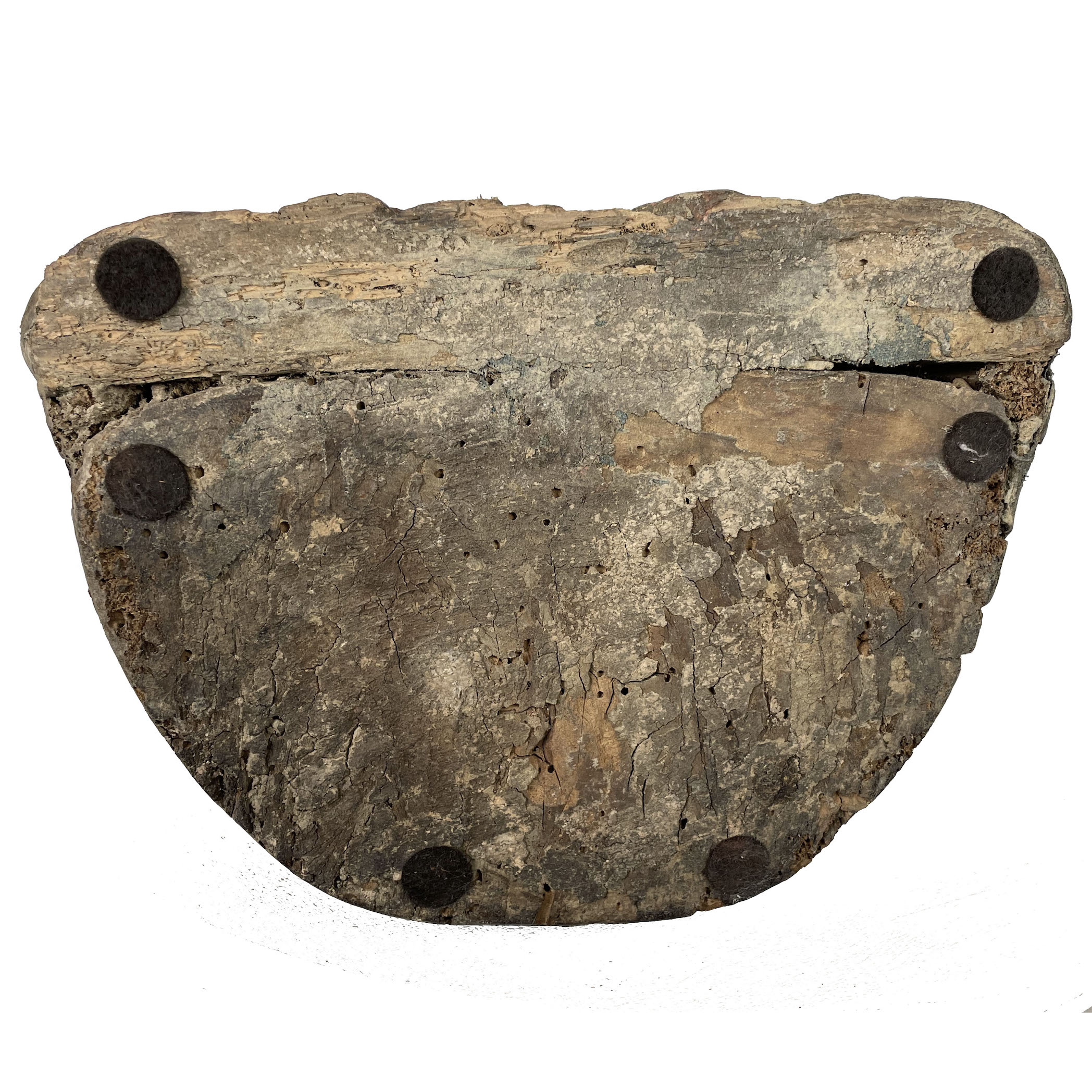
Medium size antique Buddha images are rare as they were not commonly used in home, clan or community shrines. This one, however, was likely s placed on a community shrine, private household shrine of the rich, or a clan temple. It was made to be viewed in the round with paint and gilding extending to the back of the carving, which was unusual. It has some old insect and deterioration from age that does not affect the carving’s integral structure, beauty, or value. On the contrary, they confirm its old age. The concealed closed cavity at its back indicates it was consecrated by a monk in an eye-opening consecration ceremony for placement on a shrine or altar.
AI Market Valuation Summary
AI rates this piece as Top-tier Collectors Value for the following reasons:
Although this carving shows some standard signs of normal expected age-related losses, it is a high- quality collector piece due to several crucial factors. At 14 inches, it is significantly larger than a home altar or private domestic temple shrine figure from this period which were generally made between 6 to 10 inches. Despite visible paint flaking, wood contraction splits, and weathering across the chest, knee and bottom, the key facial features—the nose, meditative mouth, and elongated ears—remain completely intact. Its authenticity is validated by its highly desirable untouched “dry” crusting finish where the layers of thick red under-lacquer (gesso) break through the remaining traces of its original gold gilding on the front and back. Its patina is soft on all sides and adds to its exceptional appearance. The sealed back cavity appears completely intact, original and likely still contains its intended 300-year-old consecration materials which dramatically increases its historical value and collector appeal.
Click here for Consecrating Wooden Images to Imbue Them with A Life Force.
Sources:
Fredrick W. Bunce, A Dictionary of Buddhist and Hindu Iconography, New Delhi, D. K. Printworld (P) Ltd., 2001. Patricia Eichenbaum Karetzky, Images of Asia: Chinese Buddhist Art, New York, Oxford University Press, 2002. Meyer McArthur, Reading Buddhist Art: An Illustrated guide to Buddhist Signs and Symbols, London, Thames and Hudson, 2002. C.A.S. Williams, Chinese Symbols and Art Motifs, New York, Dover Publications, 1978.
Additional information
| Place of Origin | China |
|---|---|
| Period | Antique, Ming/Qing Dynasties |
| Date | 17-18th Century |
| Materials and Technique | Wood |
| Dimensions (inches) | Ht: 14”. W: 9.375” D: 7.25” |
| Dimensions (metric) | Ht: 35.56cm W: 23.81cm D:18.41cm |
| Condition | Very good, see description |
| Item Number | 16089BMEM |
| Shipping Box Size | Oversized. Call 213-568-3030 or email vanishingarts213@gmail.com for shipping. |