
Home Altar

In many world religions, home altars are spiritual tables on which sacred images, symbols or texts are placed and honored with offerings made for venerating deities and/or ancestors by family members that generally include light from candles or lamps, incense, flowers, food, and water. In Buddhism, home altars are physical spaces that support spiritual practice, encourage devotees to attain enlightenment and show gratitude to the Buddha for showing the way to enlightenment. Buddha and Buddhist deity statues and other spiritual symbols remind devotees of the qualities of Buddha’s wisdom and compassion and serve to inspire devotees to develop these qualities as they recall Buddha’s teachings.

Chinese Taoist and Popular Religion family home altars or shrines (Kam or Kung) honor ancestors, attract blessings and avert malevolent forces and influences. Ancestor worship is a family affair to communicate with and provide greetings and support to the deceased, engage in prayer, display filial piety and make offerings to ancestor statues and/or tablets. Taoist, Popular Religion and Buddhist deities maybe placed along with images of Taoist and Buddhist priests, deified local heroes and legends. Home altar statues are blessed in an eye-opening consecration ceremony performed by a Taoist or Buddhist priest or monk to imbue with them with chi and give them life. Offerings of candles, incense and foods are placed to attract blessings of fu which they augmented by placing furniture in certain locations and using propitious colors (red and gold attracts the most fu).

In Hinduism, the home altar is the most important part of a household where all family actions and decisions are made, special events are celebrated, and members gather to perform daily prayers (puja) to show reverence and devotion through prayer, supplication, songs, ceremonial worship and rituals. Hindu statues, images of deities who protect the family and engender good fortune, are placed there along with other ritual items of devotion.

Home altars are now viewed as spiritual, and often meditational spaces to celebrate one’s family. Along with spiritual icons or statues, they include photos of loved ones, well-loved mementos or trinkets, hand-written notes, or letters. Additional spiritual elements include candles, crystals, or incense.

  • SOLD Antique Taoist Fertility Goddess Niangniang, China (17005)

    SOLD Antique Taoist Fertility Goddess Niangniang, China (17005)

    $6,500.00
    H: 43″  W:  15″   D:  9.75  |  SOLD

    This large rare vibrant carving is the Taoist Deity of fertility Niangniang  (“The Maiden Who Brings Children”) is often confused with Songzi Guanyin. Represented as an empress like figure, she glances serenely at 3 diminutive children, 2 males and a female extending their arms for protection. Stunning and peaceful, it is covered with gold highlights with intricate details.

  • Sale! SOLD Antique Zhenwu, The Taoist "Perfected Warrior," China (16097)

    SOLD Antique Zhenwu, The Taoist “Perfected Warrior,” China (16097)

    Original price was: $595.00.Current price is: $395.00.
    H: 12″    W:5.6 ” D:4″    |  FREE SHIPPING WITHIN CONTINENTAL U.S.!

    Zhenwu, the True Warrior, Perfected Warrior or Northern Emperor was one of the most popular TaoistDeities in the Ming and Qing dynasties known as protector of the state and the imperial family. His feet here rest on a pedestal over a turtle with a lifted head and a snake curled around his shell. Among the many interpretations this  represent beings over whom he presided including both celestial officers under his command, [and] former demons that were conquered by him. This is a fascinating carving symbolizes trusted strength. and power.

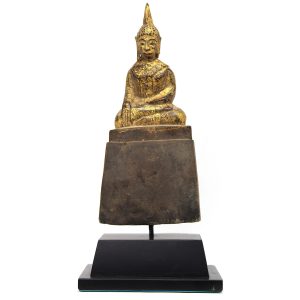
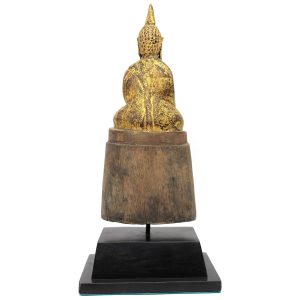
  • SOLD Vintage Earth Witnessing Buddha, Laos (3185A- ELO) $295

    SOLD Vintage Earth Witnessing Buddha, Laos (3185A- ELO) $295

    $295.00
    H: 9”  W: 4.25  D: 3.125” | FREE SHIPPING

    This mid 20th century Buddha Shakyamuni in Earth Witnessing position is carved in rural Lao style. Covered with gilt, the small rustic and simply carved image follows Lao artistic canons for depicting a Buddha: a curved hairline and high arched eyebrows that meet at the bridge of the nose, distinct hair curls, long ears, and a flame-shaped radiance emerging from his ushnisha. Its very large base is as tall and wide as the image, reflecting Laotian beliefs that a high pedestal reflects a deep respect for the Buddha. A base has been added for display purposes.  Authentic old Lao images, even small personal ones like this, are difficult to find.

End of content

End of content