Showing 37–48 of 50 results
-

$595.00
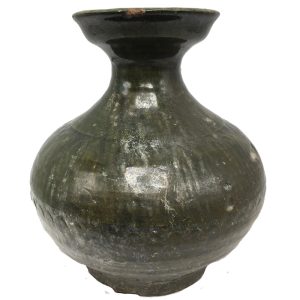
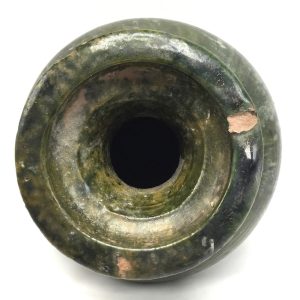
Hu vessels, first made in the Shang Dynasty is an ancient-pottery wine vessel whose body swells in the middle, flares into a narrow neck and often has a raised circular foot. Very popular during the Han dynasty, it was used as an ancestral tomb burial object (mingqi) to hold liquids and elixirs for the deceased…
-
$395.00
Ht: 6.5” W: 2.625” D: 1.75” | FREE SHIPPING WITHIN CONTINENTAL U.S.!
This ancient figurine is Harpocrates the Greek god of silence and secrets holding a jar made for a home shrine. He probably represents a royal and temple cult, as he wears a double crown symbolizing both Upper and Lower Egypt and his royal emblem signifies his association with the reigning Egyptian king, who was considered a manifestation of the Egyptian god Horus. Missing part of his right side when excavated, and no with no repairs this is a true slice of history. It pairs well with #1845 Ancient Pottery Figurine of Child Nurturer Goddess.
-
$395.00
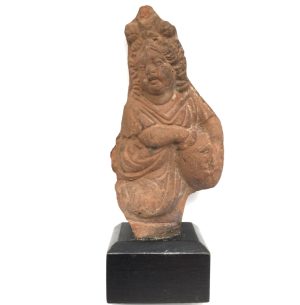
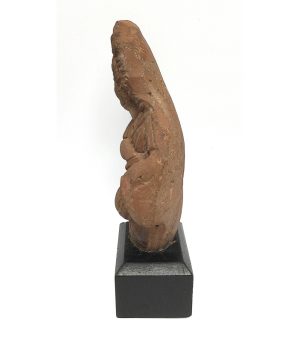
Ht: 6.75” W: 3” D: 2” | FREE SHIPPING WITHIN CONTINENTAL U.S.!
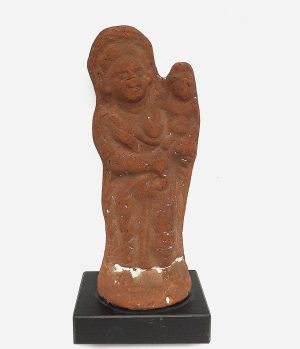
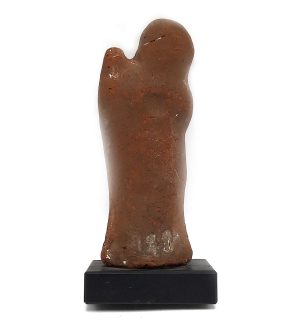
This Roman Egyptian figurine from Alexandria of a woman holding a young child is a Kourotrophos, a class goddess figures holding infants or children. Referred to as “child nurturers”, these were revered deities, cult figures and mortals who were also fertility symbols and protectors of the young. Made from a bivalve mold, this terracotta figurine was probably placed on a home altar for protection. Mother and child figures like this are universal and appear in cultures throughout the world. It pairs well with #1844 Ancient Harpocrates Figurine.
-
$1,375.00
SOLD H: 23.25″ W: 9.25″ D: 6.25″
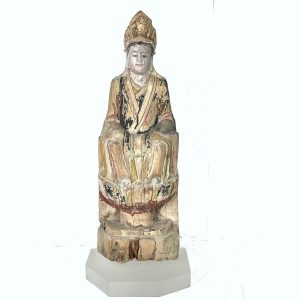
This Guanyin image was probably one of a pair of images along with the Taoist Queen Mother of the West (16206A-WACK) placed together on a community, local temple or home altar. Created by the same local artisan, they are provincial rather than imperial style having a humble, unadorned and simple rendering, seated on backless thrones, hands covered by a ritual cloth, uncharacteristic of Guanyin but common for Taoist goddesses. Both wear layered robes and a high pointed crown – the Queen Mother’s centered by a phoenix and Guanyin’s by a flower surrounded by symbolic aureole of radiating light. Both have soft blissful smiles with eyes cast slightly downwards to engage their devotees. Initially covered in bright polychrome colors, there are traces of surviving red, yellow, green, brown and black.
-
$5,900.00
H: 34″ W: 12″ D: 15″ | CALL 213-568-3030 OR EMAIL VANISHINGARTS213@GMAIL.COM FOR SHIPPING.
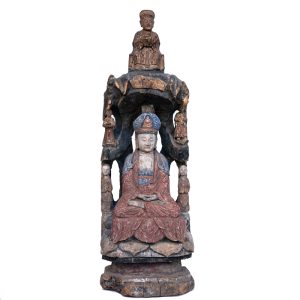
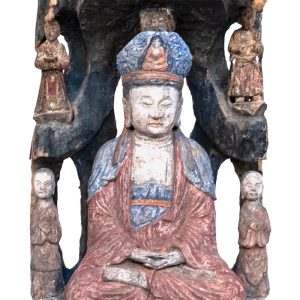
This rare and intriguing Nanhai Guanyin sits in her cave with internal layers at Putuo. On the top is the donor who commissioned the piece, seldomly placed within the Guanyin tableau.Two levels of attendant pairs flank her: the upper with her two acolytes Longnu, (the Dragon Princess) on her right holding a flaming gem, and Shan Tsai (Sudhana) on her left with hands, now missing, clasped in anjali mudra of reverence and two generic attendants are on the on the bottom. This work is truly remarkable in its execution and iconography.
-
$195.00
H: 26.5” W: 8: D: 3.5” | CALL 213-568-3030 OR EMAIL VANISHINGARTS213@GMAIL.COM FOR SHIPPING.
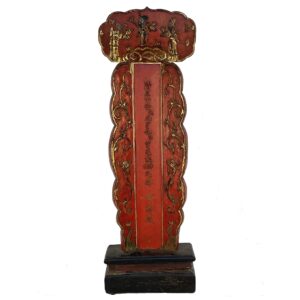
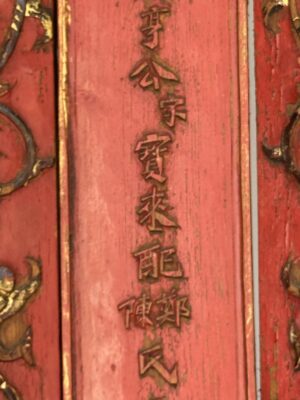
Red lacquered Ancestral Memorial Tablet with raised gold-gilded characters signifying the ancestor’s prosperity and high status These tablets are considered the home in which the ancestor’s spirit reside. The characters identify the ancestor, his two wives, and designates the tablet as a location where spirits are invited to reside and receive offerings from their descendants. Topped with a scalloped oval panel with the Three Stars Gods Fu, Lu and Shou on celestial clouds.
-
$295.00
Ht. 4.75 Dia 5.25″ | SOLD
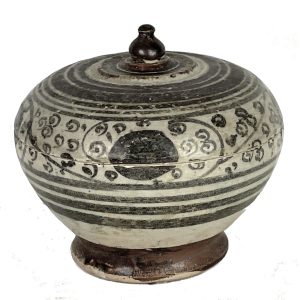
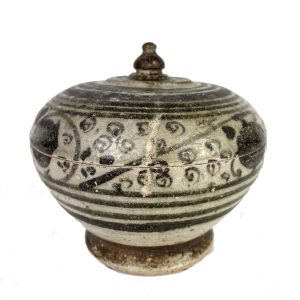
Produced in Thai kilns in the 14th to 15th centuries, Sawankhalok glazed stoneware lidded bowls were distributed through southeast Asia along with a variety of larger and smaller items. Lidded bowls like this were used to store many things, especially spices, powders and cosmetics, betel nut chewing materials, and medicine. This bowl rests on a thick foot, has a lid with a brown lotus bud handle and covered with decorative panels of underglaze brown crosshatch and vegetal scrolls.
-
$495.00
H: 11” W: 9.5” D: 2” | SOLD
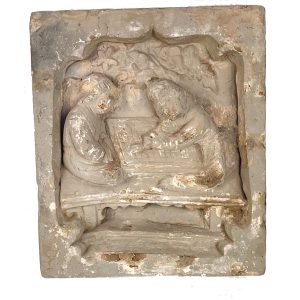
As part of the The Song dynasty cultural expansion, government and public buildings and tombs were built with interior walls decorated with earthenware unglazed mold-made brick tiles. This fanciful vibrant tile with a scalloped frame portrays two people playing a board game called wéiqí which originated in China over 2500 years ago. It is the world’s oldest and most complex board game still played.
-
$485.00
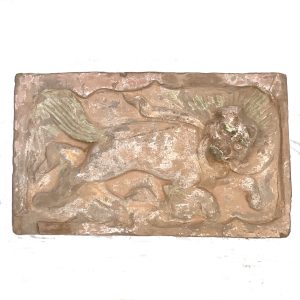
The Song dynasty (960–1279) is considered the most culturally brilliant era in later imperial Chinese history. A massive expansion during this dynasty produced government, public and religious buildings and tombs with walls decorated with earthenware unglazed mold-made brick tiles. Some were purely decorative and others were wishes for happiness and comfort in the deceased’s afterlife…
-
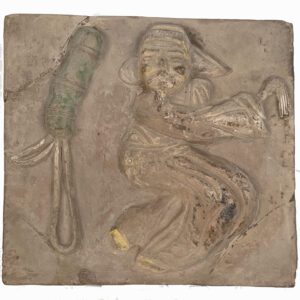
$325.00
H: 7” W: 5” D: 2.75” | FREE SHIPPING WITHIN CONTINENTAL U.S.
This Song earthenware tile depicts the legendary scholar, poet and alchemist Taoist deity Lu Dongbin, one of the Eight Immortals, who sought to discover the elixir of immortality and used charms still used in Chinese homes to prevent illness and ward off evil. He and his fly whisk are auspicious symbols of longevity and a wish for immortality. Firecrackers, are traditionally used to celebrate the Chinese New Year, to bring in wishes for a safe and prosperous year, scare away evil and provide pleasure for the ancestors’ spirit.
-
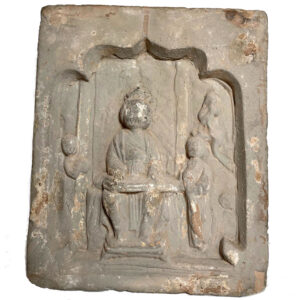
$475.00
Terracotta tile portraying a seated female musician playing a lute with 2 attendants, and a third person in the distance. The scene is framed in an attractive and decorative curved wide border with a pointed arch called an ogee arch originating in India.
-
$525.00
H: W: D: Ht: 14.75″ W:12.125″ | FREE SHIPPING WITHIN CONTINENTAL U.S.
End of content
End of content